

You found redeemaibot.com while looking for free redeem codes, and now you want to know whether it actually works — and whether it’s safe to use. The evidence used in this review were observed behavior trends of similar sites, publicly available scanner ratings and common security practices and not associated with redeemaibot.com.
Table of Contents
Key Takeaways
- What is redeemaibot.com?->This is a new website that, supposedly, utilizesthe AI, in order to produce free redeem codes that you may use to buy games, gift cards, streaming services, and more.
- Would you consider it secure? -> Several security scanners, such as Gridinsoft, mark it as suspicious, with the trust value down as low as 1/100
- Can AI actually generate valid codes? → No — valid codes are issued and encrypted by the platform itself; no outside system can generate them without authorization
- What are the real risks? → Data harvesting, ad fraud via mandatory “verification” loops, and potential malware exposure
- Already visited? → See the recovery checklist in this article before taking any further action
What Is Redeemaibot.com and What Does It Claim?
Redeemaibot.com is a website based on AI technology that allows one to produce free redeem codes for digital prizes. The codes can be related to gaming platforms, gift cards, in-app money or subscriptions of different streaming services.
The language used on this site focuses upon being fast, automated and technological. It presents its service as a method of obtaining high quality content on the internet for free, by associating the AI with this service.
The Core Promise — Free AI-Generated Codes
The central argument lies in that AI is able to find, produce or unlock unredeemed drives codes for the user. The messaging usually suggests that sophisticated algorithms are capable of skipping the regular distribution channels.
Redeemaibot.com is not unique in this framing. A wide category of websites makes similar claims, targeting users who are unfamiliar with how digital reward systems actually work.
Why This Promise Attracts Attention
Two factors drive the platform’s appeal. First, AI is widely associated with powerful problem-solving in public discourse. When platforms attach the label to their product, the association creates a sense of technical credibility — even when that credibility is unearned.
Second, digital services cost money. Games, places to stream and even app stores all follow the same pattern of billing on recurring payments. A tool that provides to ‘eliminate’ that expense is likely to appeal to these user groups – namely younger consumers or more frequent gamers who aren‘t flush with cash.
Can AI Actually Generate Valid Redeem Codes?
This is the most important technical question. The answer is no — and understanding why reveals the fundamental problem with redeemaibot.com.
How Legitimate Codes Are Created and Secured
Redeem codes issued by companies like Sony, Microsoft, Nintendo, Google, and Apple are not randomly generated strings left floating on the internet. They are created through secure internal systems, stored in encrypted databases, and tied to specific accounts or promotional events.
According to the National Institute of Standards and Technology (NIST), cryptographic key management standards require that access to such data be tightly controlled and authenticated. No external tool can query or replicate this data without authorization.
All codes are single use and verified by the server. When a code is entered on a platform the platform cross checks that code with the platform‘s own database at the time of use. No external system — AI-powered or otherwise — has access to that database.
For any outside tool to generate a valid code, it would need access to the company’s internal systems without authorization. That is not a technical gap; it is a security breach, which would be both illegal and immediately detected. As NIST’s Cybersecurity Framework notes, detecting unauthorized access attempts is a core function of any properly maintained digital system.
What “AI” Really Means on Sites Like This
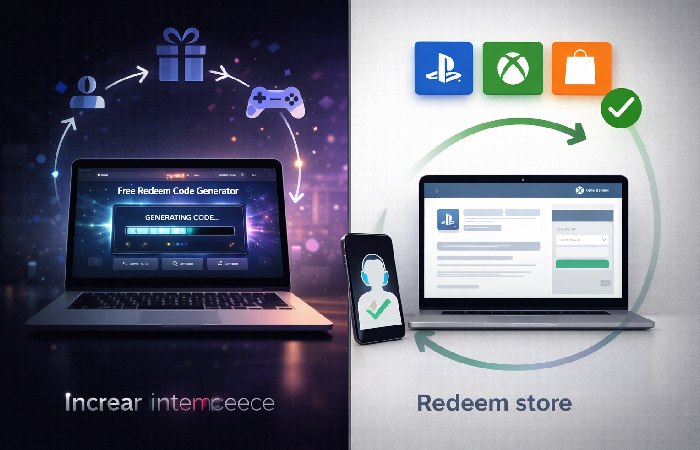
The term artificial intelligence, as used on redeemaibot.com and similar platforms, is a marketing label rather than a technical description. According to cybersecurity researchers at Malwarebytes, the “generation” process these sites display typically consists of scripted animations: progress bars, fake server connection messages, and countdown timers.
None of this reflects adaptive AI behavior. It is front-end theater designed to make users feel that something real is happening while the actual goal — keeping you on the site through a verification loop — is pursued in the background.
How Redeemaibot.com Actually Works — The Real User Journey
Understanding the user journey removes the ambiguity. The process follows a predictable pattern that security researchers have documented across dozens of similar platforms.
The Standard Pattern: Progress Bars, Animations, Verification
- You select a reward type (game currency, gift card, etc.)
- The site displays a loading animation with progress updates (“Connecting to server… Scanning database… Code found!”)
- Before the code is “released,” you are asked to verify you are human
- The verification process requires surveys, app downloads, or account registrations
- After completing those steps, you are redirected to another task — or the process restarts
In the vast majority of reports about similar sites, users say no working code is ever delivered, and the process ends in repeated redirects or an indefinite loop.
How Verification Steps Become the Business Model
Here is the part that competitors rarely explain clearly: the verification step is not a security measure. It is the product.
When you complete a survey linked from the site, the operator can earn an affiliate commission; when you download an app, they may receive a conversion fee; and when you sign up for an email list, your data can be monetized by marketers.
This business model is low-cost to operate and generates revenue whether or not a single working code is ever delivered, because no working codes are the point.
Psychological Design Tactics Used to Keep You Engaged
Sites such as redeemaibot.com are purposefully built to diminish critical thinking and draw visitors into other areas. The Electronic Frontier Foundation (EFF) has documented how deceitful design patterns influence user behavior over the internet. Five specific example approaches are regularly found on sites such as this:
Specific Dark Patterns to Recognize
- Fake scarcity messages: “Only 2 codes left for your region!” — creates artificial urgency with no factual basis
- Fake social proof counters: “47,821 users generated their code today” — unverifiable numbers meant to imply broad success
- Progress illusion: Loading bars and step-by-step animations make you feel you are almost there, even when no real process is running
- Confirmshaming: If you try to leave, a pop-up may say “No thanks, I’ll keep paying full price” — designed to make you feel irrational for not continuing
- Foot-in-the-door progression: Small initial requests escalate to larger ones; once you have invested time, you are more likely to continue
Why These Tactics Work — and How to Counter Them
These techniques exploit well-documented cognitive biases. Scarcity messaging triggers fear of missing out. Social proof exploits the tendency to trust crowd behavior. Sunk-cost thinking keeps you completing steps after you’ve invested time.
Recognizing them in real time is the counter. Ask yourself: “Has anyone I actually know confirmed they received a working code from this site?” If the answer is no, disengage before providing any personal information.
Privacy and Data Risks
What Information Gets Collected
Depending on how far you progress through the site, the following types of data may be collected:
- Email address (commonly required for “account creation” or “verification”)
- Phone number (required on some survey tasks)
- Device information (operating system, IP address, browser fingerprint)
- App installation data (if you download an app from the verification step)
- Behavioral data (time spent, clicks, patterns — used for targeting profiles)
Some of these requests appear incidental. None of them are incidental.
What Happens to That Data
Data collected through these flows is typically sold to advertising networks or used for targeted marketing. In more aggressive cases, email addresses feed into phishing campaigns — follow-up emails impersonating known brands to extract further information.
According to the Federal Trade Commission (FTC), any service asking you for personal information in exchange for an unverified benefit should be approached skeptically. The FTC‘s rule on deceptive claims is simple: if a service is unable to verify the benefit it claims to offer, then exchanging data in order to acquire this benefit may constitute deception under the FTC Act.
The National Cybersecurity Alliance (StaySafeOnline) also points out one of the most common pathways into phishing is being sent from or through a misleading website in another category of data collection. If you haven‘t opted into a company‘s privacy policy for example through an explicit name/value exchange for a set of data then the expected outcome is data will be turned into value without your participation.
Redeemaibot.com vs. Legitimate Reward Platforms
| Feature | Redeemaibot.com | Official Platform Rewards |
|---|---|---|
| Code validity | No documented working codes as of this review | Guaranteed valid, server-verified |
| Transparency | No named owner, no clear policy | Published terms, named company |
| Data handling | Unclear, likely monetized | GDPR/CCPA compliant |
| Verification requirement | Extensive, revenue-driven | None beyond account login |
| Customer support | None identifiable | Available through official channels |
| Legal standing | Operates outside code issuance terms | Fully authorized |
| Trust score | 1/100 (Gridinsoft) | Full platform authority |
What to Do If You Already Visited Redeemaibot.com
If you have already engaged with the site and provided information, take these steps immediately.
Recovery Checklist:
- If you used your main email in order to sign-up or verify, change that email password as well and turn on two-factor authentication for it right away. CISA (Cybersecurity and Infrastructure Security Agency) specifically states that multi-factor authentication is the single most effective measure you can take to secure compromised credentials.
- Monitoring app installation. Remove any apps you have downloaded during a verification step by deleting the apps and running a malware scan with a reputable scanner. I recommend the freely available Malwarebytes there is a good deal of independent security professional recommendation for this program.
- Revoke app permissions. If any downloaded app asked to access device permissions (camera, contacts, location), use phone settings to revoke access straight away. Apple‘s support information regarding iOS and Google‘s Android security recommendations both recommend the importance of routinely auditing app permissions as a key security technique.
- Keep an eye on your inbox. Watch out for future email messages claiming that you have a prize, giving a code, requiring immediate account action all common follow-up phishing emails. Follow the trends by subscribing to the Anti-Phishing Working Group APWG‘s free monthly newsletters.
- Reporting the site. Report these sites to the Federal Trade Commission at ReportFraud.ftc.gov or to the Anti-Phishing Working Group at reportphishing.antiphishing.org. By taking action against these sites you can cause them to be removed from search engines and help protect other users of the web.
- If your gaming account details have been entered, update them straight away on the official platform and activate two-step verification.
Where to Get Real Redeem Codes Safely
There are genuine ways to obtain redeem codes and digital rewards. None of them involve AI generators.
- Official promotions: Art Gamers and streaming services promote game codes on their official Facebook, Twitter, Tumbler and all their official accounts on YT or other official channels and mailing lists. this is thefrench method(their Facebook account).
- Retailer promotions:. Codes from physical or digital gift cards bought from major retailers such as Target, Amazon, Best Buy, or Walmart.
- Rewards programs: Microsoft Rewards, Google Opinion Rewards and other similar first party programs are genuine points to rewards schemes. They do involve real effort but they do provide a reward.
- Twitch drops and in-game events: Many games provide free in-game items and codes via Twitch stream, in-game events or holidays. This is annonced on their website.
- Promotion bundles: Adverts promote special mobile deals and encourage convergent shopping. Customers who by certain new hardware, or products gains access to bundled deals codes. Open advertising is standard for retailers and developers.
The theme that runs through all these deals: valid codes have a company, named contact published terms and traceable history. If any of those three is not present then don‘t put any stock into the deal, however convincing the platform might appear.
Who Should Avoid Sites Like Redeemaibot.com
Best for: No documented user group. There is no verified use case where redeemaibot.com delivers working results.
Proceed with awareness: Users who want to understand how these sites work for research or educational purposes, provided no personal data is entered.
Avoid entirely:
- Younger users or those new to online platforms — the psychological design is particularly effective on less experienced users
- Anyone who would use their primary email, phone number, or gaming account credentials in the process
- Anyone on a shared or work device — malware risk extends to other users on the same network
Frequently Asked Questions
Q: Is redeemaibot.com safe to use?
A: Multiple cybersecurity services, including Gridinsoft, currently classify redeemaibot.com as suspicious with trust scores near zero. There is no evidence the site delivers working codes. The primary documented risk is data collection via mandatory verification steps and potential malware exposure from app downloads.
Q: Can AI actually generate valid redeem codes?
A: No. Valid redeem codes are generated and stored within a platform’s own encrypted database. As NIST’s cryptographic standards confirm, no external system can produce a working code without direct, authorized access to that database. The AI label on sites like redeemaibot.com is a marketing description, not a technical one.
Q: What are “verification steps” and why does the site require them?
A: Verification steps are positioned as anti-bot security measures but function as revenue streams. Any survey filled out, app downloaded or form submitted on those links will produce a commission or lead-generation income to the site owner. The user gets nothing in return.
Q: I completed the verification steps and shared my email. What should I do?
A: Change your email password and activate 2-factor authentication immediately, as advised by CISA. Be vigilant of coming phishing emails, particularly if received an unlikely email message relating to prizes, account confirmation, etc. If you personally requested the file, remove the app and scan for malware (Malwarebytes or similar).
Q: Where can I find legitimate free redeem codes?
A: The security of social media accounts on official gaming platforms, players getting details via deals/advert-isements through retailers, the use of Microsoft Rewards, the use of Google Opinion Rewards, and events within the game is assured. Each has a clear set of terms and does not acquire personal data apart from the general account login information.
Q: Why does redeemaibot.com appear in search results if it’s not legitimate?
Sites employing this method aggressively optimize every corner of their site (usually in the form of a lot of content on a lot of www.com domains) to take advantage of brand-name based search terms. Ranking for this does not prove trust but optimization.
Disclaimer
This article is for information and educational purposes only and is written based on general knowledge and security best practices during time of writing based on public knowledge. We are not related to redeemaibot.com in any form nor we are responsible, and have any influence on, which whatever is linked here. We do not determine legally about any specific website or any service. Users are responsible for their own judgment, check on the official documentation, and contact the related professionals for legal, finance and cyber security advice.