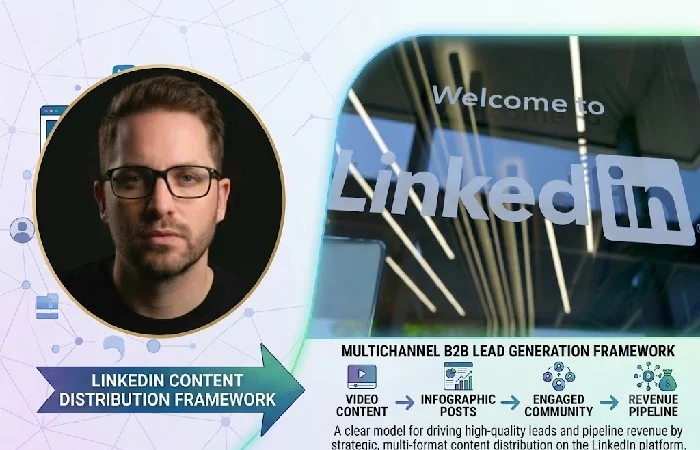
Most B2B content marketing fails at distribution, not creation. Teams invest weeks producing a report or a thought leadership piece, publish it on the company page, and watch it reach a few hundred people before it disappears. The problem is rarely the quality of the content. It is the absence of a system to repeatedly put that content in front of the right buyers in the channel where they actually make decisions.
For B2B, that channel is overwhelmingly LinkedIn. The platform drives roughly 80 percent of B2B leads sourced from social media. In the Content Marketing Institute and MarketingProfs annual benchmarks, 84 percent of B2B marketers said LinkedIn delivers the best value of any social platform. If your content strategy treats LinkedIn as one channel among many, you are underweighting the one place your buyers congregate. At the same time, single-channel outreach is seeing declining returns, which is pushing B2B teams toward coordinated, multi-channel distribution rather than reliance on any single tactic.
This article lays out a distribution framework that B2B teams can adapt to turn published content into measurable pipeline, with the metrics to track at each stage.
Table of Contents
Why distribution beats volume
The instinct when content underperforms is to produce more of it. That compounds the original problem. A single strong asset distributed across ten touchpoints will almost always outperform ten weak assets published once each.
The shift is from a publishing mindset to a distribution mindset. Every piece of content should have a planned distribution sequence before it is written, not after. This is where most content calendars break down. They schedule creation and publication dates but leave amplification to chance.
The four-part distribution framework
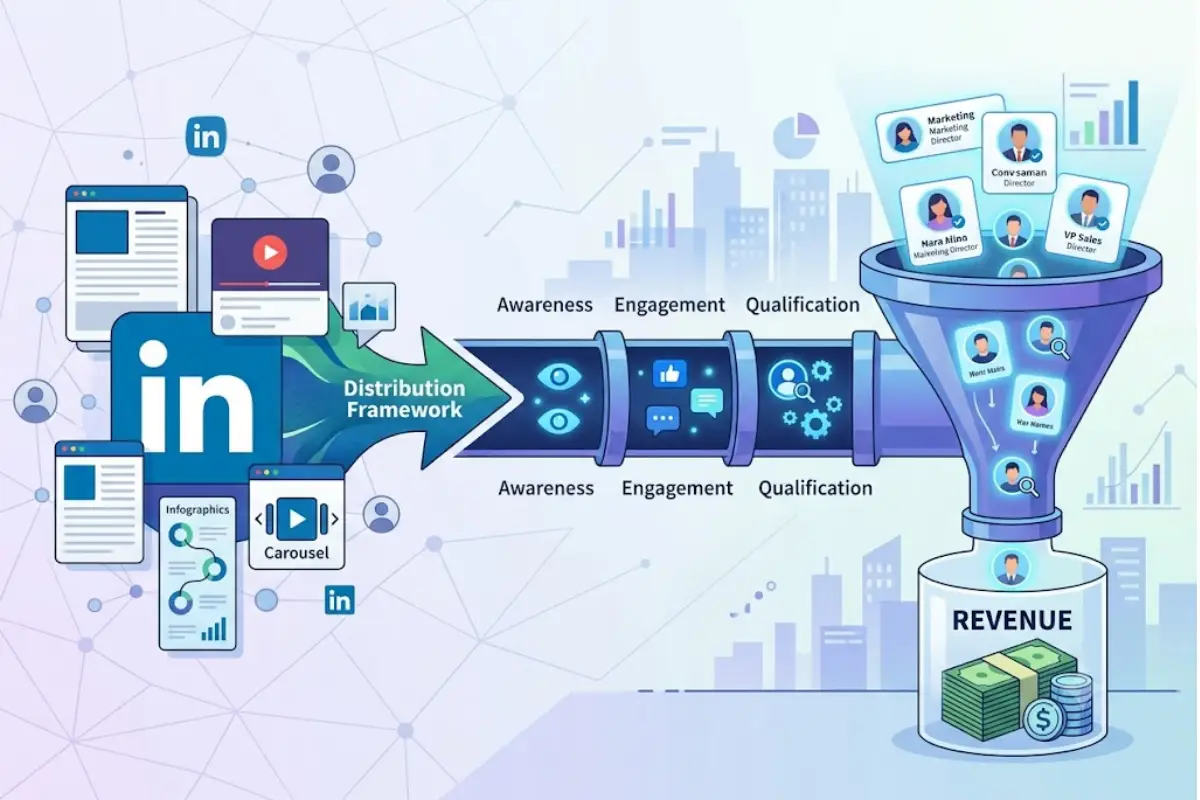
1. Content-to-demand mapping
Match each content format to a funnel stage before you create it.
- Top of funnel: short opinion posts, data snippets, and industry commentary designed for reach and profile visits.
- Middle of funnel: frameworks, how-to breakdowns, and case studies that demonstrate competence and earn saves and shares.
- Bottom of funnel: specific results, comparisons, and customer outcomes that move an engaged reader toward a conversation.
Mapping content this way means every post has a job. You stop publishing generic updates and start building a sequence that walks a buyer from awareness to intent. For teams building this out methodically, a structured approach to LinkedIn for B2B lead generation connects each content stage to a defined next action rather than leaving engagement to dissipate.
2. Personal versus company page amplification
Company pages have low organic reach. Personal profiles, particularly those of founders and senior staff, consistently earn several times more engagement on identical content. LinkedIn’s own data shows that content shared by employees typically sees notably higher engagement than the same content posted by the brand page. The most effective B2B distribution model publishes the canonical asset on the company page, then amplifies it through personal profiles with a distinct point of view attached.
This is not duplication. The company’s post states the position. The personal post adds the human angle: what the author learned, where they disagree, and what surprised them. Same underlying content, two very different engagement profiles.
3. Cadence and repurposing
One asset should generate a month of distribution, not a single post. A practical repurposing cycle from a single piece of research:
- Announcement post with the headline finding
- Carousel breaking down the three key takeaways
- Personal narrative on why the research mattered
- Short video or audio summary
- Discussion post asking the audience to weigh in
Five touchpoints, one source asset, spread across three to four weeks. Consistency of cadence matters more than the polish of any single post.
4. The conversion layer
Reach is not pipeline. The step most teams skip is the deliberate move from engagement to conversation. When a target buyer engages with a post, that is a signal, and it has a short shelf life.
A simple, repeatable workflow: monitor engagement on amplified posts, identify engagers who match your ideal customer profile, then open a relevant, non-pushy conversation referencing the content they engaged with. This is the bridge between content marketing and pipeline, and it is almost always the weakest link in the chain.
What to measure
Vanity metrics like impressions and likes tell you almost nothing about pipeline. Track the progression instead:
- Engagement rate on amplified posts (early signal of resonance)
- Profile visits following a content push (intent indicator)
- Connection acceptance rate from ideal-profile engagers
- Reply rate on conversations opened from content engagement
- Meetings booked attributable to a content sequence
The benchmarks back this up. HubSpot’s analysis puts LinkedIn’s visitor-to-lead conversion rate at 2.74 percent, more than three times Facebook’s 0.77 percent and the highest of any major social platform. Format choice compounds the effect: LinkedIn’s own engagement data shows that multi-image carousels and native document posts consistently earn the highest engagement, ahead of single-image and link posts. The pattern is consistent: the gain comes from matching format to intent and distributing deliberately, not from producing more content.
Where this applies
This framework fits B2B companies with a defined ideal customer profile and an average deal size that justifies a consultative sales motion, typically in professional services, SaaS, and B2B agencies. Smaller teams can run it with one or two active personal profiles. Larger organizations can scale it across a roster of subject matter experts.
Expect a ramp. The first four to six weeks build cadence and baseline engagement, and first meetings typically land in a 30 to 60-day window as accounts warm and messaging is refined against real responses. Resourcing is modest relative to paid acquisition: budget roughly three to five hours per week of writing and engagement time per active profile, plus a small tooling spend for scheduling and engagement tracking, rather than a large content production budget.
Key takeaways
- Distribution, not creation, is the bottleneck in most B2B content programs.
- Plan the distribution sequence before you write the asset.
- Map every format to a funnel stage so each post has a job.
- Amplify through personal profiles, not just the company page.
- Repurpose one asset into a month of touchpoints.
- Build a deliberate conversion layer; reach without conversation is not pipeline.
- Measure the progression from engagement to meetings, not vanity metrics.
The companies that win at B2B content marketing are rarely the ones producing the most. They are the ones who distribute what they produce with intent and who treat every engaged reader as the start of a conversation rather than the end of a post.