
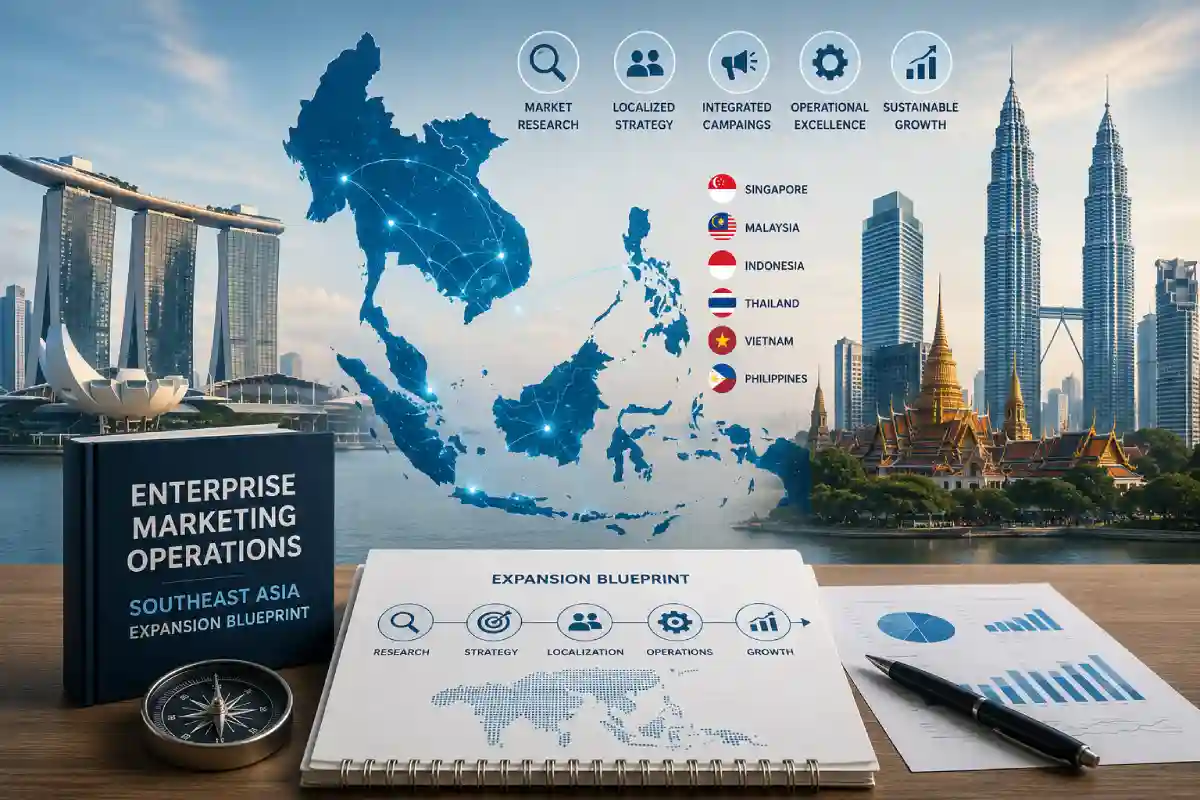
Southeast Asia is rapidly becoming the focal point for enterprise marketing operations worldwide. As digital participation deepens and consumer behaviour evolves at breakneck speeds, the region presents a massive and relatively untapped landscape for international brands looking to scale. By 2030, millennials and Generation Z are projected to account for roughly half of all consumers in the Asia-Pacific (APAC) area, heavily driving the region’s rapid adoption of digital payments. The economic opportunity is undeniable for those willing to commit. In fact, with the region’s digital economy projected to exceed $300 billion in gross merchandise value according to a 2025 report by Bain & Company, enterprises can no longer afford to treat Southeast Asia as an afterthought. To capture this explosive growth, marketing decision-makers must move beyond remote campaigns and build dedicated regional frameworks.
Table of Contents
Overcoming Cultural and Operational Barriers
Deploying a unified marketing campaign across an area as culturally fragmented as the Asia-Pacific requires a highly sophisticated approach. While regional digital advertising spend is forecast to reach $311.4 billion in 2026, simply translating English copy into local languages will not guarantee success. The APAC region currently generates over 70 percent of global social commerce revenue, indicating a fundamental shift in how buyers interact with brands. Furthermore, local consumers heavily rely on regional super-apps, demanding a bespoke approach to digital integration and customer journey mapping that cannot be managed remotely.
Experts agree that entering new global markets successfully demands a profound alignment with regional search behaviours, cultural subtleties, and technical web localisation. Brands need dedicated teams on the ground to interpret these complex variables and adjust their messaging in real time. Without physical proximity to the target audience and a deep understanding of local dialects and customs, even the most generously funded enterprise campaigns risk falling flat. Establishing a local presence bridges this cultural gap and ensures campaigns resonate authentically.
Building a Strategic Marketing Base
To truly master cross-cultural marketing, corporations need a robust operational headquarters within the region. A central base allows marketing teams to consolidate resources, hire native creative talent, and manage budgets efficiently across multiple Southeast Asian time zones. It also provides a vital anchor for navigating the diverse advertising standards and data privacy regulations across ASEAN nations, which can introduce immense complexity for marketing data collection.
For many international enterprises, establishing a business in Singapore acts as the most logical first step when setting up an APAC hub. Ranked first globally in operational efficiency in the World Bank’s Business Ready 2024 report, the city-state offers a highly digitised, business-friendly environment with minimal trade barriers. Major global entities have recently expanded their regional operations and AI innovation hubs here, drawn by the progressive regulatory environment. Operating from a legally sound corporate structure in a central location enables marketing directors to focus entirely on scaling their brand securely.
Key Tactics for Adapting Campaigns to APAC Consumers
Once the structural foundations are firmly in place, enterprise marketers must adapt their tactical deployment to fit Southeast Asian consumption habits. Mobile usage dictates approximately 71 percent of total digital time across the region. Consequently, traditional desktop-first web assets often yield poor engagement rates in these emerging markets.
To maximise regional impact, enterprises should focus on the following strategies:
- Prioritise social commerce integration: Social media platforms now capture one in four e-commerce dollars spent across Southeast Asia. Marketing channels must seamlessly link to direct purchasing options to satisfy consumers who prefer frictionless checkouts within their favourite applications.
- Leverage retail media networks: Growing at a rapid 14.1 percent year-on-year, retail media currently outpaces both online video and standard social media advertisements. Brands should allocate larger portions of their digital ad spend to these high-intent digital environments.
- Partner with micro-influencers: Rather than broadcasting through massive global celebrity accounts, brands should engage with local micro-influencers (those with 2,000 to 10,000 followers). These creators tend to generate engagement rates four times higher than macro-influencers, offering the hyper-local authenticity that consumers crave.
- Adopt a mobile-first app strategy: Nearly 45 percent of Singaporean consumers prefer interacting with brands via mobile applications. This rate is significantly higher than in many Western markets and reflects an always-on, digitally native consumer base.
Creating a successful marketing strategy for Southeast Asia is not just about increasing media spend or translating existing assets. It requires a fundamental shift in how campaigns developed, deployed, and managed structurally from a legal and operational standpoint.
By building a localised operational hub and embracing community-driven, mobile-first tactics, global brands can secure a permanent foothold in one of the world’s most dynamic and lucrative digital economies.