

You searched “how welcituloticz discovered” expecting a real answer. Maybe something about a scientist, a breakthrough, a forgotten chapter of research history. And Google gave you results — articles about two researchers wandering through a forest, stumbling upon a “dazzling blossom,” and changing the course of science forever.
Sounds compelling. One problem — none of it happened.
Welcituloticz isn’t a discovery.
This guide breaks down exactly what we found when we manually reviewed the main pages currently ranking for this term — who’s behind the articles, why they exist, what red flags to watch for, and how you can fact-check any unfamiliar “discovery” in under a minute.
Table of Contents
What You Need to Know
- “Is welcituloticz real?” — No.
This is a made-up, absurd word; it appears nowhere in any real database or text.
- “What are those Google articles about?” — AI-generated fiction published by guest-post content farms to capture search traffic and ad revenue.
- “Who’s behind these pages?” — A connected network of low-quality domains: CraneFest, DigitalEnginelands, HorizonWaveTech, OnFintechZoom — all running “Write For Us” guest-post operations.
- “Are those sites safe to visit?” — Proceed with caution. Several host gambling links, darknet marketplace spam, and aggressive ad scripts.
- “How do I fact-check this myself?” — Search PubMed, Google Scholar, or Wikipedia for the term. Zero results = fabricated.
What Is “Welcituloticz”? The Short Answer
Welcituloticz is a fabricated, nonsensical keyword with no basis in science, history, medicine, or any legitimate field of study. Nothing. That’s the answer. It’s used exclusively by AI content farms and guest-post networks to generate fictional “discovery story” articles designed to capture search traffic and ad impressions. As of April 2026, there are no hits for on PubMed, Google Scholar, Wikipedia, Britannica or other academic search engines on any sites we searched.
That’s the full answer. There’s no deeper layer.
But the very ability to type it into Google and turn up page after page reliably describing its “discovery” with scientists unnamed, jungle expeditions decried, and medicine affected is worth taking in of itself. So, let‘s examine what those pages have to say.
What Top Google Results Claim About How Welcituloticz Discovered

Here’s what’s strange. The pages ranking for this term don’t just mention welcituloticz in passing. They tell entire stories about it — detailed, structured narratives with headings, timelines, and fictional characters. And they contradict each other.
The “Forest Discovery” Narrative
DigitalEnginelands.com publishes a version where “two young researchers made an incredible discovery while exploring a forest.” They found a “dazzling blossom.” Word spread “by radio waves and books.” Technology, medicine, and education — all three, somehow — began applying the ideas.
The article is authored by “admin.” No credentials. No bio. The only external link points to the Wikipedia page for “Innovation.” Comments are closed.
The “Scientific Serendipity” Narrative
HorizonWaveTech.com tells a different story. In their version, welcituloticz was a biological phenomenon studied through “genetic sequencing” and “remote sensing” by “Dr. Smith” and “Dr. Johnson.” The article has a duplicate “Key Takeaways” section — the same block pasted twice, which is a classic sign of automated content generation. And it’s filed under “Space Technology,” despite describing what’s supposedly a biological discovery.
Why These Stories Contradict Each Other
Because neither is based on anything real. When you’re writing fiction about a word that doesn’t exist, there’s no source material to keep the stories consistent. Each content farm’s AI tool generated a different narrative from scratch — same keyword, different hallucination.
Who’s Publishing These Articles — and Why
Ever wonder who’d bother writing a 700-word article about a word that doesn’t mean anything? It makes more sense when you see the business model.
The Guest-Post Farm Network
Every site ranking for “how welcituloticz discovered” operates on the same model. They’re multi-niche blogs — covering everything from “LegalTech” to “Home and Living” to “YouTube” — with a prominent “Write For Us” page. That page is the real product. These aren’t publications. They’re platforms that sell or accept guest posts, often for backlink placement.
Here’s what we found when we crawled them:
- CraneFest.com publishes articles about “Votanizhivoz,” “Lotanizhivoz,” “Hegahmil Venambez Injury,” “Palsikifle Weniomar Training,” and “Is Qiokazhaz Spicy.” Every single article uses a fabricated nonsensical word as its subject. Hundreds of them. The author “John Lewis” has an exposed Gmail address in the page source.
- DigitalEnginelands.com also hosts articles titled “Dropbox 8737.idj.029.22” and “Python SDK 25.5a Burn Lag” — strings that aren’t real product names or topics.
- OnFintechZoom.com has a tag cloud containing dozens of fabricated strings like “6-8dj-9.8koll1h” and “huzoxhu4.f6q5-3d” alongside gambling keywords.
How Fabricated Keywords Generate Traffic
The strategy is straightforward. Pick a keyword nobody else has targeted — because it doesn’t exist — write an AI-generated article about it, and index the page. If anyone searches that term (even accidentally, even out of curiosity about another site’s article), your page ranks #1 by default. No competition. The page collects ad impressions. Scale this across hundreds of nonsensical keywords and the revenue adds up.
Google‘s spam policies (updated 23rd January 2007) state that ‘automatically generated content whose primary purpose is to manipulate search engine rankings’ is a breach of the policy. However, this must be a slow process. With new spam sites replacing the old every day,
The “Write For Us” Business Model
The secondary revenue stream is selling guest posts. Businesses and individuals pay to place articles (with backlinks) on these domains, hoping to boost their own site’s authority. The content farms use fabricated-keyword articles to pad their site’s page count and make the domain look active and content-rich — even though almost none of it serves a real reader.
Red Flags That Expose Fake Articles
Not sure whether an article you’re reading is legitimate or content-farm spam? Here’s what we found across every page ranking for welcituloticz.
What We Found Across Every Ranking Page
| Red Flag | HorizonWaveTech | DigitalEnginelands | CraneFest |
|---|---|---|---|
| Real author with credentials | “David Spangler” — no bio, no profile | “admin” — no identity at all | “John Lewis” — Gmail exposed in source code |
| Sources or citations | None | 1 link to Wikipedia “Innovation” page | None |
| Category makes sense | Filed under “Space Technology” for a biology article | Filed under “How To” | Filed under “Youtube / Website” |
| Consistent content | Duplicate “Key Takeaways” section (pasted twice) | Single narrative, no contradictions internally | Page body appears empty — broken or gated |
| Comment section | Clean | KRAKEN darknet spam links in comments | N/A |
| Other content on site | Mix of niche blog topics | “Dropbox 8737.idj.029.22” and similar nonsense titles | 100% fabricated-word articles |
| “Write For Us” page | Present | Prominently featured | Present |
That table alone should give you enough to evaluate most unfamiliar sites. But let’s talk about something more concerning.
Safety Risks — What Happens When You Click These Links
Content-farm spam articles aren’t just useless. Some are actively risky.
Gambling and Darknet Spam Exposure
When we checked, OnFintechZoom hosted tags for “Situs togel,” “slot777,” and “Cricket ID Providers” — all gambling-related keywords. When we checked, the DigitalEnginelands comment section contained links to KRAKEN, a darknet marketplace. These aren’t accidents. They’re either paid placements or signs of compromised site security. Either way, clicking through these sites — especially on mobile, where aggressive redirects are harder to avoid — carries real risk.
Aggressive Ads, Data Harvesting, and Phishing Patterns
Sites in this network typically run high-density ad scripts. Some serve pop-unders or auto-redirect ads that can lead to phishing pages, fake download prompts, or browser notification spam. If you’ve already visited one of these sites and clicked “Allow” on a notification prompt, go to your browser settings and revoke that permission now. Seriously — those notification permissions are how spam sites push ads directly to your device long after you’ve left.
Why Indian Users See These Results
If you’re searching from India, you’re probably seeing more of these content-farm results than users in other markets. There’s a reason for that.
India’s English-language search market has one of the highest volumes of guest-post and content-farm activity globally. The combination of a massive English-speaking internet population, relatively lower content moderation enforcement, and a high density of low-DA domains creates an environment where fabricated-keyword strategies are especially profitable. Google’s algorithm improvements — including the helpful content system updates — are gradually filtering these out, but the volume of new spam pages often outpaces enforcement.
That’s the frustrating part. There isn’t a quick fix on the search engine side. So the practical solution is learning to spot these patterns yourself.
How to Fact-Check Any “Discovery” in 60 Seconds
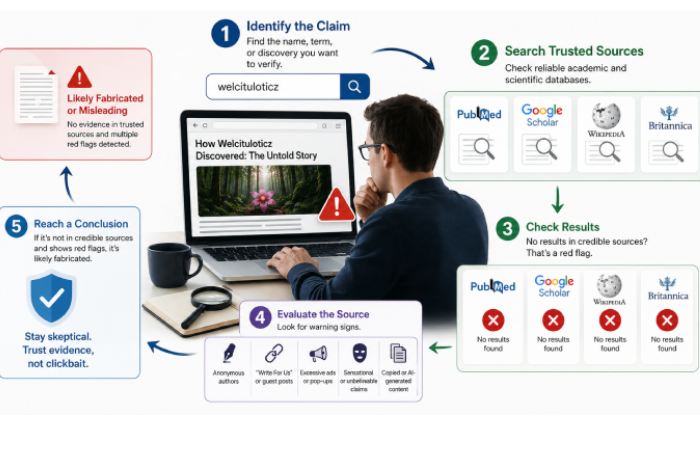
Here’s a framework you can use whenever you encounter an unfamiliar term, concept, or “breakthrough” online. It’s a compact five-step process you can usually complete in about a minute.
- Search the term on PubMed — covers virtually every published medical and life-science paper. If a discovery is real and medically significant, it will appear here. Zero results for an “important breakthrough” is a serious red flag.
- Try Google Scholar Google Scholar (scholar.google.com) is broader than PubMed and covers most scientific fields. Search the exact term. A total absence of results, for a term described as important, tells you almost everything you need to know.
- 3. Check Wikipedia Wikipedia isn’t perfect, but legitimate scientific discoveries generally have pages or appear in footnotes of related articles. A term that doesn’t appear anywhere on Wikipedia, despite supposedly having major medical or societal impact, is almost certainly fabricated.
- 4. Look at the author A real researcher will have a name, an institutional affiliation, and usually a Google Scholar profile or ORCID. “Admin,” a first name only, or a name with no bio at all are red flags. No name, no credentials, no affiliation? Stop reading.
- 5. Evaluate the site itself A “Write For Us” button in the navigation, dozens of unrelated articles on the same domain, thin layout, and aggressive ads are all immediate signals that you’re not on a credible publication. If the same site publishes articles about “Hegahmil Venambez Injury” and “Is Qiokazhaz Spicy,” you’re on a content farm. Close the tab.
That’s the whole process. Four steps, under 60 seconds. And honestly — if more people used even the first step, content farms would have a much harder time.
Research from Stanford’s Internet Observatory consistently shows that most users don’t verify online claims at all. The students, professionals, and casual readers who do verify gain a significant advantage in avoiding misinformation — and it costs almost nothing.
Common Mistakes When Evaluating Online Content
A few patterns trip people up consistently:
- Assuming a top Google result is trustworthy. Ranking position is a signal, but it’s not proof of quality — especially for low-volume or fabricated keywords where competition is zero.
- Trusting articles because they “sound scientific.” Terms like “genetic sequencing,” “remote sensing,” and “ecosystem relationships” appear in the welcituloticz articles. They sound legitimate. But name-dropping real scientific methods doesn’t make the subject real.
- Ignoring the author. This one’s quick to check and catches most content-farm articles immediately. No name, no bio, no credentials? That’s your answer.
- Skipping the site’s “About” page. Content farms either don’t have one or list a vague description with no verifiable team, address, or editorial policy. Real publications are transparent about who they are.
Who Should Read This (and Who Can Skip It)
This guide is most useful for:
- Anyone who searched “welcituloticz” and wants a straight answer
- Students and teachers building digital literacy skills
- Parents who want to help their kids evaluate online sources (especially relevant for school research projects in India where Google is often the first stop)
- SEO professionals studying content-farm patterns and spam SERP dynamics
You can skip this if:
- You already know the term is fabricated and just wanted confirmation (confirmed — it’s fake)
- You’re looking for actual scientific discovery content (try searching for specific, verified topics instead)
The Bottom Line
Welcituloticz isn’t real. The “discovery story” doesn’t exist. Every page ranking for “how welcituloticz discovered” is publishing AI-generated fiction through a network of guest-post content farms — sites that also host gambling spam, darknet links, and hundreds of other articles about equally fabricated terms.
The good news? You can spot this kind of content in seconds. Start by checking the author, then check PubMed and the site’s other content. If a domain publishes articles about “Palsikifle Weniomar Training” and “Is Qiokazhaz Spicy” alongside the article you’re reading, close the tab.
And if you’re here because something felt off about those search results — trust that instinct. It was right.
If you’re researching welcituloticz for a class or project, don’t cite any of the currently ranking pages — there’s nothing there that can be used as a reliable source.
Frequently Asked Questions
Q: Is welcituloticz a real scientific discovery?
Q: Is welcituloticz a real plant or species?
A: This does not exist. There is no record of any living organism, plant, biological item, in any of the scientific taxonomies, including GBIF, ITIS, NCBI Taxonomy Browser named welcituloticz. The story of the dazzling blossom is fabricated.
Q: Who discovered welcituloticz?
A: Nobody. The “discovery stories” you’ll find on Google are AI-generated fiction. One site credits “Dr. Smith” and “Dr. Johnson” (generic placeholder names). Another describes “two young researchers” with no names at all. These aren’t real people or events.
Q: Why does Google show articles about welcituloticz if it’s fake?
A: Because Google’s algorithm indexes and ranks content based on relevance signals — keywords, structure, internal links. When nobody else publishes content about a term, even a low-quality spam page can rank #1 by default. Google’s spam detection catches many of these pages over time, but new ones appear faster than enforcement can keep up — particularly for obscure, zero-volume keywords where there’s no legitimate content to surface instead.
Q: Are websites about welcituloticz safe to visit?
A: Be cautious. Several of these sites are serving gambling related pages (slot777, Saudi 777), links to darknet marketplace pages (KRAKEN) and aggressive ad scripts. Do not click on download links, disable notifications from your browser and do not supply personal data on these domains. If you have enabled notifications on any of these sites, then go into your browser preferences and disable notifications from them.
Q: How can I tell if an online article is AI-generated content-farm spam?
A: Four quick checks usually catch it. First — look at the author. “Admin” or a name with no bio and no credentials is a red flag. Second — check for sources. Real articles cite real research. Third — look at the site’s other content. If titles include strings of nonsensical words, you’re on a content farm. Fourth — search the article’s main topic on PubMed or Google Scholar. Zero results means the subject likely doesn’t exist.
Disclaimer
This article is an independent factcheck of a fictitious keyword, based on an examination of search results and publicly available web pages as of April 2026. It is not medical, legal, financial, or professional advice use it only in place of the advice of appropriately qualified professionals. Any references to particular web sites are pedagogic and do not represent an endorsement. Repeat each check mentioned in the report in your own judgment before trusting and act on any information.
About the Author:
Abdul Rahman, has more than 4 years of experience writing about consumer electronics, laptops and IT support solutions in Ireland and the UK. He simplifies complicated repair terms into easy, useful advice so you can be sure of your buying decisions.
Published by: www.globalmarketingguide.com, a convenient source of content on business, health, technology and lifestyle that strives for relevance and use rather than sophisticated implementations and complex concepts.