

Last updated: 19 May 2026
You typed “furtherbusiness com” into Google because something made you pause. Maybe a friend shared a link. Maybe an article ranked for your query. Maybe you’re just checking — is this site real, is the advice safe, and is it built for someone running a business in India?
Good questions. And honestly, most of the pages that rank for this term don‘t answer them directly.
Short version: FurtherBusiness.com Niche and Value-Add ‘Content’ blog e.g. marketing, finance, sales & productivity. Built as a business growth resource. Not a SaaS, not an official directory, not associated with big-wigs of Indian business. Useful for inspiration. May be a disaster if treated as the ultimate resource on money, tax & legal.
This is an easy-to-follow description of what the site really does, the information available on its public “About” page, how it stacks up against larger websites, and most importantly, a straightforward checklist Indian users should read before they take action based on anything published there.
Methodology: Used public information and general guidelines for evaluating business and YMYL (Your Money or Your Life) content as of May 2026. This is not a comprehensive review of the articles of FurtherBusiness.com, so double-check with the site and authoritative sources before taking any critical actions.
Table of Contents
Key takeaways
- What it is -> An all-around business content blog including marketing, finance, CRM, and productivity.
- Who is responsible for it -> As of May 2026, the author‘s byline was not visible on the public About page, which listed a Gmail contact address and a WhatsApp number with a +92 country code (no named editors were visible).
- Best for -> beginners and side-hustlers who want light, easy-to-read business ideas.
- Not for → Anyone making tax, legal, investment, or compliance decisions in India — use official sources for those.
- Our verdict → Read it as a starting point. Cross-check anything financial or legal with an Indian regulator or qualified professional.
What is FurtherBusiness.com?
FurtherBusiness.com, a content-only business blog, delivers articles on marketing, finance, sales funnels, CRM, and small-business productivity. It is not a software product, not a directory and not a consultancy/official advisory service. Consider this a repository of opinionated and how-to articles, good for scanning ideas, less good for binding decisions.
Judging from the screenshots that our colleagues have put out, and reviews, it seems the homepage is generally large, business themes of finance, marketing, sales, and tools, with articles on CRM startup, Influencer marketing, content strategy, and getting paid personal finance hacks. The writing is simple. Too simple at times, which may help beginners, but less helpful for someone looking for anything in depth.
Is FurtherBusiness.com legit and safe to use?

According to the public About page, the site’s About section lists a generic Gmail contact (blooginga@gmail.com) and a WhatsApp number with a +92 country code, which is Pakistan — not India, not the US, not the UK. That doesn’t automatically mean anything is wrong — plenty of small teams work cross‑border — but for Indian readers, it’s a cue to pay extra attention to how India‑specific the advice really is.
Independent write‑ups also note an absence of clearly visible author bylines, an editorial masthead, corporate registration details, or obvious third‑party verification on the site. That doesn’t make the content false. Plenty of useful blogs run on minimal infrastructure. But Google Search Quality Rater Guidelines stresses that the more a topic straddles money or wellbeing, what Google calls YMYL (Your Money Your Life), the more carefully you should scrutinise the source. As business, tax, and investing topics are categorised as YMYL by Google, any site giving you money-related tips should be considered your starting point only. Cross-check important points with the real Indian authorities, such as Income Tax India, GST Council, RBI, or SEBI, before you action them, or otherwise consult a professional.
So treat the site the way you’d treat any anonymous business blog. Useful for ideas. Not a substitute for advice from a Chartered Accountant, a SEBI-registered advisor, or the RBI’s official communications on banking and payments.
What does FurtherBusiness.com actually publish?
The homepage shows a mix of evergreen explainers and lightly opinion-led posts. Nothing exotic. Here’s the realistic breakdown.
- Marketing posts — CRM for startups, influencer marketing basics, content strategy walk-throughs, call-center tips.
- Finance posts — Investment strategy primers, 30+ personal finance tips, broker reviews, and separating business and personal expenses.
- Sales and operations: Builds sales funnels, uses tools to improve productivity, and nets ideas for lead generation.
-
External brand references: Posts such as “Financecub.com Review” or platform write-ups (such as the Quotex broker post) indicate some level of affiliate or partner integration. Outsiders reading some of the tool lists on FurtherBusiness.com have commented on some promotion-like placement and potential sponsored/affiliate placement that may not be clearly labeled. If you have a strong view on this, take the recommendations with a pinch of salt and ensure there is clear disclosure before using.
From what’s visible in public reviews and post previews, many articles look like short to medium‑length explainers rather than deep guides. Tone is friendly and beginner‑oriented. Depth is patchy — strong on basics, thin on Indian regulatory specifics (GST, MSME registration, RBI rules, Income Tax compliance).
A small but useful test you can run yourself: open any finance article, search the page for “consult”, “verify”, “RBI”, “SEBI”, or “Chartered Accountant”. If those words are missing from a piece about investing or business banking, treat that post as starter content only.
How FurtherBusiness.com compares to bigger platforms
For Indian readers, the real question isn’t whether furtherbusiness.com is “good.” It’s whether it gives you more than a free platform you already know.
| Platform | Depth | Indian Context | Editorial Trust | Best Use |
|---|---|---|---|---|
| FurtherBusiness.com | Light–medium | Generic/global | Low (no named editors) | Casual reading, idea sparks |
| YourStory | Medium–high | Strong Indian focus | Established editorial team | Startup news and founder stories |
| Inc42 | High | Strong Indian focus | Funded, named journalists | Indian startup funding, policy, deep dives |
| HubSpot Blog | High | Global / B2B | Strong authorship | Marketing, sales, CRM education |
| Entrepreneur India | Medium | India-focused | Brand-backed | General business reads |
| Investopedia | High | Global (US-leaning) | Editorial standards visible | Finance term explainers |
For high‑stakes money, tax, or compliance questions, pair content blogs with at least one official or regulator‑backed source.
| Need | Blog‑style starting point | Official / regulator source to cross‑check |
|---|---|---|
| Income tax slabs & deductions | FurtherBusiness.com, Investopedia | Income Tax India portal, CBDT circulars |
| GST rules for small businesses | General business blogs | GST Council and CBIC updates |
| Investment products & brokers | General reviews, blog posts | SEBI, RBI, and the broker’s own SEBI registration details |
Always treat the blog as context, and the official source as the final word before you move money or file anything.
The honest read? FurtherBusiness.com sits below all of these on signals like authorship, editorial transparency, and Indian regulatory accuracy. It isn’t trying to compete with them either — it’s a general blog. Just don’t expect an Inc42-level breakdown of an RBI circular there.
Our Trust Scorecard for FurtherBusiness.com
This scorecard is our own internal framework for reviewing any content site that gives business or money advice. We rate five visible trust signals from 0 to 2 (maximum 10) purely to explain how an editor might assess the site’s transparency and reliability — it is not an official rating, and the site owner cannot ‘opt in’ or ‘opt out’ of it.
Here are the five trust signals we look at for any anonymous business blog:
- Transparency of authors: Which named authors, bios, and credentials appear?
- Editorial policy: Can you see any policy on corrections, sources, and updates?
- Contact legitimacy: Has a real-world business address, a named team, and a verifiable domain contact been provided
- Citation quality: Is the content linked to primary sources, regulators, and studies?
-
Local/regulatory accuracy: Does the content correctly mention the local regulators (RBI, SEBI, GST, MCA) when providing India-specific advice?
Who is FurtherBusiness.com actually for?
Best for:
- College students are learning what a CRM or sales funnel is for the first time.
- First-time side-hustlers looking for plain-language explanations.
- Local shop owners are curious about basic online marketing — not as their only source, but as a starting point.
- Readers who like short, easy posts and use them as a launchpad into deeper reading.
Not a good fit for:
- Anyone deciding on taxes, GST, or registration for a real Indian company … see a CA, Startup India, or the MCA portal.
- Checking out brokers, mutual funds, or stocks, SEBI-registered advisors, and SEBI‘s investor portal are the right places to start.
-
B2B buyers who are comparing enterprise tools (where pricing, contracts, or compliance are known considerations) use vendor websites and trusted review sites such as G2 or Capterra.
- Anyone who needs Indian regulatory accuracy on finance, employment, or data privacy.
If you fall in the second bucket, the site isn’t a problem — it’s just the wrong tool for the job.
Common mistakes Indian readers make with sites like this
Most of these aren’t unique to FurtherBusiness.com. They apply to any anonymous business content site.
- Having the blog post as advice. Would a 900-word lesson about personal finance substitute a one-hour call to an SEBI-registered advisor? It can be the question-easing… so to say, that‘s the right job for such a ‘lesson’.
- Missing the cross-reference. If an article mentions a tax slab, a deduction, or a scheme name, consult the authoritative reference before you take any action. Open Income Tax India, GST Council or MCA.
- Not paying attention to the no author signal. I mean, if you can‘t distinguish who wrote something, then there is no way to distinguish what his motive was in writing it. Affiliate links, sponsored placement, and personal opinion all read the same on the page.
-
Mistaking simplicity for expertise. Writing is simple and reader-friendly. But simple doesn‘t always mean accurate. An easily understood incorrect answer remains an incorrect one. If you are uncertain whether an offer or ‘too-good-to-be-true’ money proposal is genuine, check the offer‘s or the scheme‘s pattern against the general guidance issued by the regulator, consumer protection authority, etc for instance, the Reserve Bank of India‘s advisories on unapproved lending apps; Securities and Exchange Board of India‘s investor education programme on unapproved schemes.
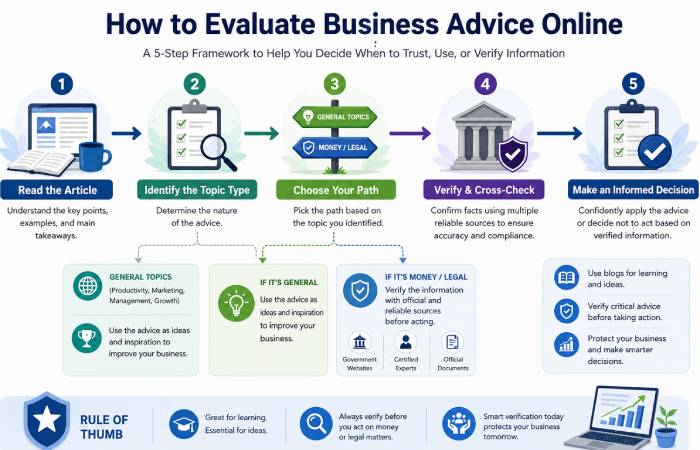
A simple 4-step verification checklist for any business content you read online
Bookmark this. Use it the next time any business blog — furtherbusiness.com or otherwise — tells you to do something with money, tax, or contracts.
- Find the author. No name, no LinkedIn, no credentials? Drop the trust level by half.
- Trace the source. For any number or claim, can you click through to a regulator, a study, or a primary report? If not, treat it as an opinion.
- Check the date. Indian tax slabs, GST rules, and RBI circulars change. A 2022 post on “current” rates may be outdated.
- Run the India test. Ask: Would this still be true under Indian law, Indian banking, or Indian SME realities? If you’re not sure, ask a professional before acting.
If a post fails two of these, it’s still fine to read. Just don’t act on it. You can reuse this same 4‑step checklist for any business blog, YouTube channel, or social media advice thread. The goal is not to make you paranoid — it’s to slow you down just enough before you share data, send money, or change how you file taxes or manage your business.
Final verdict: Should you use FurtherBusiness.com?
Honestly? Use it the way you’d use a free magazine in a coffee shop. Flip through, pick up an idea or two, and don’t base a tax filing on it.
If you’re newer to business content and just want to browse ideas, the site is harmless and occasionally useful. If you’re past that stage, your time is better spent on Inc42, YourStory, HubSpot, or Investopedia for global concepts — and on official Indian sources for anything regulatory.
That’s the practical answer. Less exciting than a five-star or one-star verdict. But closer to the truth.
Frequently Asked Questions
Q: Is furtherbusiness.com a real website?
Yes. It’s a live content blog publishing general business and finance posts. Real doesn’t automatically mean authoritative — it just means the site exists and updates.
Q: Who owns FurtherBusiness.com?
Q: Can I trust the financial advice on furtherbusiness.com?
Q: Is there a FurtherBusiness.com login or membership?
Q: What are good Indian alternatives to FurtherBusiness.com?
For Indian startup news, YourStory and Inc42. For marketing and CRM, HubSpot’s blog. For finance concepts, Investopedia, plus the official RBI and SEBI investor portals. Different jobs, different tools.
Q: Is ‘for further business’ the same as furtherbusiness.com?
No. ‘For further business’ is a phrase used in formal business English to mean ‘for additional business matters.’ FurtherBusiness.com is a specific website. Sometimes Google blends both into the same set of search results, which can look confusing at first glance