
You’ve seen the WhatsApp forward. Maybe it was a YouTube reel or an Instagram story — someone claiming CashStark.com hands out free Airtel recharge like candy. Just sign up, do a few tasks, and your ₹299 prepaid plan pays for itself.
Sounds good, but the bottom line is: CashStark.com is not officially affiliated with Airtel. It‘s an independent third-party task-and-earn site that rewards users for performing tiny tasks watching ad videos, answering small surveys, installing apps, etc. Those points can supposedly be redeemed for mobile recharges or UPI cash. Some users report small payouts. Others report wasted hours and nothing to show for it.
This guide breaks down what CashStark actually does with Airtel recharge claims, whether the earning math makes any sense, the safety risks most articles won’t mention, and verified alternatives that don’t put your data at risk. For all those who‘ve seen the hype and are looking for a candid opinion before they give you their number..
Table of Contents
Key Takeaways
- CashStark + Airtel connection? → None. CashStark is an independent, unverified third-party site. Airtel has no partnership or endorsement.
- Can you earn free recharge? → Technically yes, but expect about ₹50–200/month for roughly 7–10 hours of effort — usually in the ₹20–₹30/hour range at best.
- Is it safe? → Mixed signals. No phishing flags, but hidden domain ownership, clone sites, and aggressive data collection raise concerns.
- Better alternatives? → Airtel Thanks App, Google Opinion Rewards, and UPI cashback on PhonePe/Paytm offer safer, verified returns.
- What should you do right now? → Check TRAI’s Sanchar Saathi portal if you’ve already shared personal details with any unverified recharge site.
At a glance: Should you use CashStark.com?
What Is CashStark.com?
CashStark.com is a task‑based rewards website that appears on a relatively new domain registered in 2024. It positions itself as a “make money online” platform — part blog, part earning dashboard — where Indian users complete micro-tasks to accumulate points they can convert into mobile recharges or small UPI payouts.
The site covers a grab-bag of content categories. Tech tips, stock market primers, education articles, SIM-related tutorials. But the core draw — the thing that brings people here through search and social media — is the promise of free recharge for Jio, Airtel, Vi, and BSNL users.
Who Runs CashStark and When Did It Launch?
Here is where the story gets thin. Because the sites are privacy-protected, you don‘t get the real owners name, although one of the sites (cashstark.in) supplied a founder name it doesn‘t appear to be verified by a LinkedIn profile for that person, company registration number or business address.
That doesn’t automatically mean it’s a scam. Plenty of legitimate sites use WHOIS privacy. But for a platform asking users to enter mobile numbers and complete tasks involving app installs, the lack of transparency stands out — especially when you compare it to established reward platforms like Google Opinion Rewards or TaskBucks, which operate under known parent companies.
How Does CashStark Claim to Give Free Recharge?
The business model runs on advertising revenue. Here’s the pipeline:
- Advertisers pay CashStark to show you ads, surveys, and app-install prompts
- You complete those tasks and earn points in your CashStark wallet
- Once you hit a minimum threshold (typically 500 points), you redeem for a ₹50 mobile recharge or UPI transfer
- CashStark keeps a margin from what advertisers paid and passes a fraction to you as the “free” recharge
So the recharge isn’t free in the truest sense. You’re trading your time and attention — and in many cases, your personal data — for a small cut of ad revenue. The advertiser pays. CashStark profits. You get ₹50 after considerable effort.
Is CashStark.com Connected to Airtel in Any Way?
No. And this needs to be stated clearly because the SERP for “cashstark com airtel” is filled with articles that blur this line — sometimes deliberately.
Airtel (Bharti Airtel Ltd.) is one of the major telecom providers in India and under the control of the Telecom Regulatory Authority of India (TRAI). Any real Airtel deals such as cashback, referral incentives and loyalty schemes are available only through:
- The Airtel Thanks App (available on Google Play and App Store)
- The official website at airtel.in
- Authorized retail outlets and payment partners
These official channels are described in Airtel’s own customer‑facing communication and terms, and third‑party offer sites like CashStark are not listed there.
CashStark.com doesn’t appear on any Airtel partner page, press release, or official communication. The two entities share no business relationship. When CashStark or its clone sites mention “Airtel exclusive benefits” or “Airtel free recharge,” they’re describing their own redemption feature — the ability to apply earned points toward an Airtel prepaid top-up — not an Airtel-sanctioned promotion.
Common myths vs reality
- “If it shows Airtel’s logo, it must be official.” → Logos can be copied; only trust offers listed on the Airtel app or airtel.in.
- “If a friend got one free recharge, the offer is guaranteed.” → One successful redemption does not mean the platform is safe or reliable long‑term.
That distinction matters. If something goes wrong with a CashStark redemption, Airtel’s customer support won’t help you. You’re dealing entirely with an unverified third party.
How Does CashStark Work for Airtel Users?
Ever wondered what the actual process looks like — not the hyped-up version from a YouTube thumbnail, but the plain reality? Here’s what a typical user journey involves.
Signing Up and Navigating the Dashboard
Visit cashstark.com. The landing page pushes recent blog posts and a signup prompt. Registration asks for an email or mobile number and a password. No OTP verification on most accounts — which is convenient, but also means there’s minimal identity protection if the account gets compromised.
The dashboard shows your point balance, available tasks, and a wallet section for redemptions. There’s a Hindi language toggle. Mobile experience loads reasonably fast on mid-range Android devices.
Earning Points Through Tasks
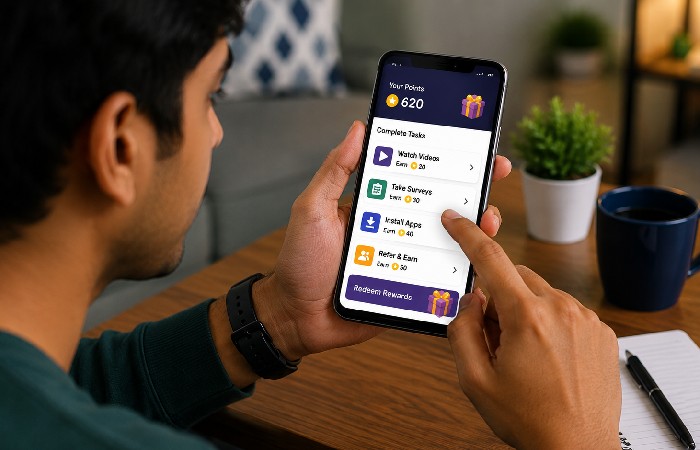
The “Earn” section lists micro-tasks in a few categories:
- Ad videos (10–20 points each): Watch 15–30 second clips on topics like mutual funds or budget apps. Quick, but the loop gets repetitive fast.
- Surveys (50–150 points each): Answer questions about shopping habits or app preferences. Takes 5–10 minutes per survey. Questions often repeat across sessions.
- App installs (100–300 points each): Download a promoted app and leave it open for 1-2 minutes. Just watch out on this one sometimes, highly promoted apps ask for permissions that have little to do with app function (although your contacts, storage and location are fair game).
- Referrals(500 pts): Give a link away here. Earn bonus points when someone registers and completes any tasks.
Redeeming Points for Airtel Recharge
Hit 500 points. Go to Wallet → Redeem. Select your operator (Airtel, Jio, Vi, or BSNL), enter your mobile number, and confirm. The minimum recharge denomination is ₹50.
Processing times vary. Some users report 1–2 hours. Others describe 24–48 hour delays, especially for UPI cash withdrawals. There’s no guaranteed SLA published anywhere on the site.
Is the Earning Worth Your Time? A Realistic Breakdown
This is where most “CashStark free recharge” articles stop being honest. They list the steps, say “easy money,” and move on. But the math tells a different story.
| Metric | Realistic estimate |
|---|---|
| Points per 15‑minute session | 70–100 |
| Sessions needed to reach 500‑point threshold | 5–7 sessions |
| Total time to earn one ₹50 recharge | About 90–105 minutes |
| Effective earning rate | Roughly ₹28–₹33 per hour |
| Monthly earning (at ~20 minutes per day) | Around ₹50–₹200 |
The figures here are rough estimates given average supply of tasks and reviews submitted and are in no way super accurate but, no matter how accurate they are, they are definitely not guaranteed and will be far lower if, in the case of redemptions, task supply is very low.
And that’s the optimistic scenario. Factor in failed redemptions, surveys that disqualify you mid-way, or app installs that don’t register points — problems multiple users have reported on forums — and the real return drops further.
Should you do it? Depends entirely on what else you’d do with that time. If you’re genuinely idle and comfortable with the data trade-offs, small earnings are possible. But calling it “free recharge” stretches the definition. You’re paying with hours.
Red Flags and Safety Risks You Should Know
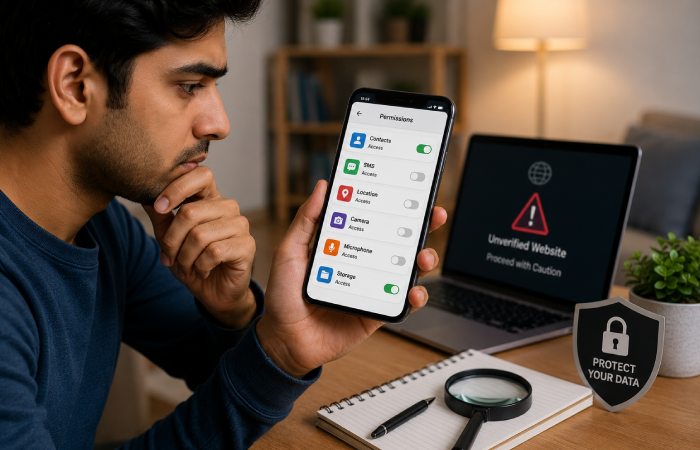
Not everything about CashStark screams scam. The site has a valid SSL certificate, and major security scanners like Scamadviser haven’t flagged it for active phishing. But “not flagged for phishing” and “safe to trust with your data” aren’t the same thing.
Quick red‑flag score (0–5)
Give each item 1 point if the answer is “yes”:
- The site hides owner details and has no business address.
- You see several lookalike domains with slightly different spellings.
- The site promises “instant free recharge” just for entering a number.
- It asks for SMS read permissions, contact access, or UPI PIN.
- You cannot find any mention of the site on Airtel, Jio, or TRAI portals.
If your score is 3 or more, treat the site as high‑risk and avoid entering personal data.
Data Privacy Concerns
Every task you complete generates data. Your mobile number, email, device information, app usage patterns, survey responses — all of it flows to CashStark and, through promoted apps, to third-party advertisers. The platform‘s privacy policy (where there is one) is not platform-specific and details about retention periods and sharing arrangements with other third parties are not specified to the extent as one would require for a platform managing Indian users’ data under the Digital Personal Data Protection Act, 2023.
This article is not legal advice, but a practical overview to help you recognise when a site may not be treating your data with the care Indian law expects.
Practical risk: Some users who shared their primary mobile numbers say they noticed more spam calls and SMS in the weeks after signing up, although it is hard to prove a direct causal link. Correlation isn’t proof, but it’s a pattern worth noting.
Clone Domains and Typosquatting Patterns
Here’s something that many quick review articles overlook. CashStark doesn’t exist as a single domain. The search results show:
- cashstark.com
- cashstark.in
- cashstark.net
- cashstarker.com
- ccashstark.com
- cash-stark.com
That’s six variations ranking for essentially the same queries. Legitimate platforms — Google, Paytm, PhonePe — don’t spawn clusters of typosquat domains pushing similar content. This pattern is commonly associated with ad-revenue farming networks where multiple domains amplify each other’s traffic.
Does that mean all six are run by the same person? Not necessarily. But it means the CashStark “brand” has either lost control of its name or never had it — and users clicking any of these domains face unpredictable levels of safety.
What TRAI and Cybersecurity Experts Say
TRAI — the Telecom Regulatory Authority of India — has never endorsed any third-party free recharge website. Full stop.
Through the Sanchar Saathi portal, the Department of Telecommunications actively encourages citizens to report suspected fraud communications — including websites that promise telecom benefits in exchange for personal information. The portal’s Chakshu facility is specifically designed for this purpose.
Cybersecurity organizations like CyberPeace Foundation have documented how “free recharge” websites are among the most common phishing vectors targeting Indian mobile users. The pattern is consistent: promise a telecom benefit, collect personal data, monetize through ads or sell the data downstream.
If you’ve already shared personal details with CashStark or any similar site and notice unusual activity, report it through India’s national cybercrime portal or call the helpline at 1930.
If you already signed up: 4 steps to reduce risk
- Change passwords on any accounts where you reused the same login.
- Revoke unnecessary app permissions on your phone (SMS, contacts, location) for apps you installed via tasks.
- Enable SMS and email alerts for bank and UPI transactions so suspicious activity is caught early.
- Save screenshots or emails related to suspicious recharge offers in case you need to file a complaint.
Safer Ways to Get Free or Discounted Airtel Recharge
You don’t need a third-party task site to save on your Airtel bill. Several official and verified channels offer real discounts — backed by companies you can actually hold accountable.
Airtel Thanks App Rewards
The Airtel Thanks App is the single most underused tool by Airtel prepaid users. Current verified features include:
- Refer-a-Friend: Earn ₹51 per successful referral. Stack five referrals and that’s ₹255 — enough to cover a basic prepaid plan.
- UPI Cashback: Airtel frequently runs cashback offers on UPI transactions made through the app. Amounts vary by campaign.
- Data Coupons: Certain recharge plans include bonus data coupons claimable inside the app. Most users never open the “Coupons” tab to check.
- Partner Rewards: Rotating offers from food delivery apps, digital services, and retail brands.
Airtel savings checklist (5 minutes)
- Open the Airtel Thanks app and tap “Discover Airtel Thanks.”
- Check if you have any unclaimed data coupons or partner offers.
- Look for active UPI cashback banners before your next recharge.
- Use your referral link for the next friend or family SIM activation instead of sharing offline.
These aren’t hidden tricks. They’re official features, backed by Airtel’s customer support if anything goes wrong.
UPI Cashback on Recharges
Platforms like PhonePe, Google Pay, and Paytm regularly offer 5–10% cashback on prepaid recharges. Caps vary (usually ₹50–150 per transaction), and offers rotate monthly. But unlike CashStark, the cashback is instant, the platform is regulated, and your data is handled under established privacy policies.
Verified Reward Apps
If you truly like earning by doing tasks these apps have proven track record. Google Opinion Rewards has short survey questions which usually pay you few paise for each and every response as Google Play balance or UPI/PayPal published by Google. TaskBucks has free mobile recharge/bill payments or wallet cash for doing app trials and tasks as user reviews says it does pay but lower. Both of these do not offer “free recharge in 10 minutes” like websites does but both are more realiable then websites like CashStark which no one really knows.
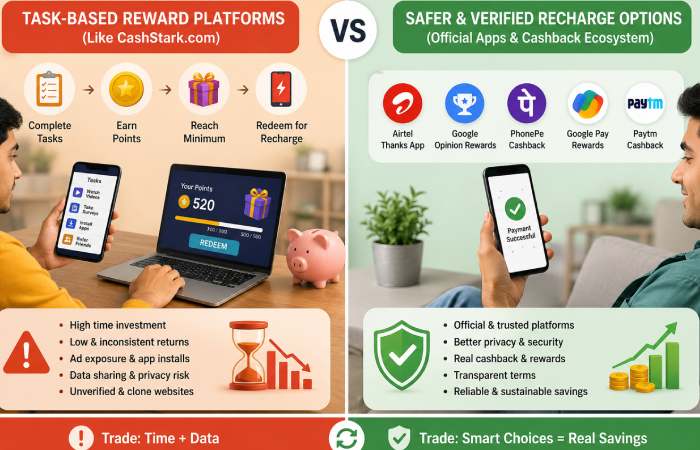
CashStark vs safer recharge options
| Option | Who runs it | Effort level | Typical monthly benefit | Data / safety profile |
|---|---|---|---|---|
| CashStark.com | Unverified third party | Medium–high (tasks, installs) | ~₹50–₹200 (if redemptions succeed) | Ownership unclear, multiple clone domains, generic privacy policy |
| Airtel Thanks App | Airtel | Low (normal usage + referrals) | ₹50–₹300+ depending on offers and campaigns | Backed by operator, support channels, clear terms |
| PhonePe / Google Pay / Paytm cashback | Regulated fintechs | Very low (just doing normal recharges) | 5–10% cashback per offer, with caps | Established brands, audited systems, clearer privacy policies |
| Google Opinion Rewards / TaskBucks | Google / known company | Low–medium (surveys/tasks) | Small but consistent credits over time | Transparent apps with public reviews and store ratings |
How to Verify Any Free Recharge Website Yourself
CashStark isn’t the last site that’ll promise you free recharge. So instead of just giving a verdict, here’s a 5-point checklist you can apply to any platform making similar claims. Use it every time.
You don’t need to tick every box to decide. Even one or two serious warnings — like no business details plus multiple clone domains — are enough reason to walk away and look for safer offers.
The Free Recharge Site Verification Checklist:
- Check domain age & WHOIS: whois.domaintools.com. Any domain created less than a year ago, who has privacy on their WHOIS data flags up the adwat. A warning light, but not conclusive.
- Search for a reliable business: Does a company‘s name, registration number or street address appear on the site? Is it indexed on the Ministry of Corporate affairs website (mca.gov.in)?
-
Scan with confidence tools: Use Scamadviser.com and Google Safe Browsing (transparencyreport.google.com) to analyze this url. Determine if there are indications of phishing or malware.
- Verify whether the company gives you identifiable company information. For example, does it give a name, registration number, or address? Is it registered at mca.gov.in
-
Scan with trust tools: Google the URL and check it on Scamadviser.com and Google Safe Browsing transparencyreport.google.com. See if it‘s marked for phishing or malware.
This process takes under five minutes. It’s worth doing before entering a single personal detail.
Who Should Try CashStark — and Who Should Skip It
Not every tool is a scam, and not every tool is worth your time. CashStark sits in an uncomfortable middle.
Might work for you if:
- You have 15–20 minutes of genuinely idle time daily (commute, waiting rooms)
- You use a burner email and secondary phone number — never your primary credentials
- You set a strict time cap and don’t chase points beyond it
- You treat any earnings as a small bonus, not a reliable income source
- You’re willing to create a simple “burner setup”: a separate Gmail address, a low‑importance secondary number, and no reuse of your usual passwords on the site
Skip it if:
- You value your time above ₹30/hour
- You’re uncomfortable sharing your mobile number with an unverified platform
- You expect consistent, guaranteed payouts
- You’ve encountered any of the clone domains and aren’t sure which one is “real”
- You want Airtel-specific support or guarantees — CashStark can’t provide those
Final Verdict
CashStark.com isn’t a straightforward scam — users have received small payouts, and the site doesn’t exhibit active phishing behavior based on current security scans. But it’s also far from the “free Airtel recharge” goldmine that viral forwards make it seem.
The reality: you’re trading time, attention, and personal data for a small cut of advertising revenue. The hourly return is low. The data privacy protections are unclear. The cluster of clone domains raises trust questions that the site hasn’t addressed. And Airtel — the operator most commonly mentioned alongside CashStark — has zero involvement.
For most users, the Airtel Thanks App, UPI cashback offers, and verified reward platforms offer better returns with dramatically lower risk. If you do try CashStark, use a burner setup, set a time limit, and never share OTPs, UPI PINs, or banking credentials.
Disclosure: This article is published on www.globalmarketingguide.com. We do not claim to be associated with CashStark.com, Airtel or any telecom operator discussed in the article. All information including our claims about CashStark working are derived from the publicly available information, user recounts and security tool scans available as on May 2026. Check independently for present state.
3 questions to ask yourself before using CashStark
- Am I comfortable earning at roughly ₹30 per hour in exchange for my data?
- Would I still sign up if this site did not mention Airtel or “free recharge” in the headline?
- Do I have a safer, simpler way to save the same ₹50–₹200 using official offers?
If the honest answer to any of these is “no,” you probably don’t need CashStark at all.
Frequently Asked Questions
Q: Is CashStark.com safe for Airtel recharge?
Depends on your definition of “safe.” No active phishing flags exist on major scanners, and some users do receive small recharges. But the domain owner’s identity is hidden, the privacy policy lacks specifics on data handling, and clone domains muddy the picture. If you try it, use a secondary number — never your primary Airtel number linked to banking or UPI.
Q: Does Airtel officially support or endorse CashStark?
No. Airtel has no partnership, sponsorship, or any stated relationship with CashStark.com. Every official Airtel promotion runs through the Airtel Thanks App or airtel.in. Any CashStark page claiming “Airtel exclusive benefits” is describing its own redemption feature, not an Airtel-backed offer.
Q: Can Airtel block my number for using sites like CashStark?
A: Browsing a thirdparty site will not normally block your number However, if you get caught in a scam, Spam, Fraud or breaking telecom regulations your connection might be indirectly affected. That is why it is better to go through normal Airtel channels and stick to known apps.
Q: How much free recharge can you realistically earn on CashStark per month?
Between ₹50 and ₹200 if you spend 15–20 minutes daily on tasks. That’s roughly 7–10 hours of total effort per month for returns that won’t cover even a basic ₹299 prepaid plan. The effective rate works out to ₹13–33/hour depending on task availability and redemption success.