
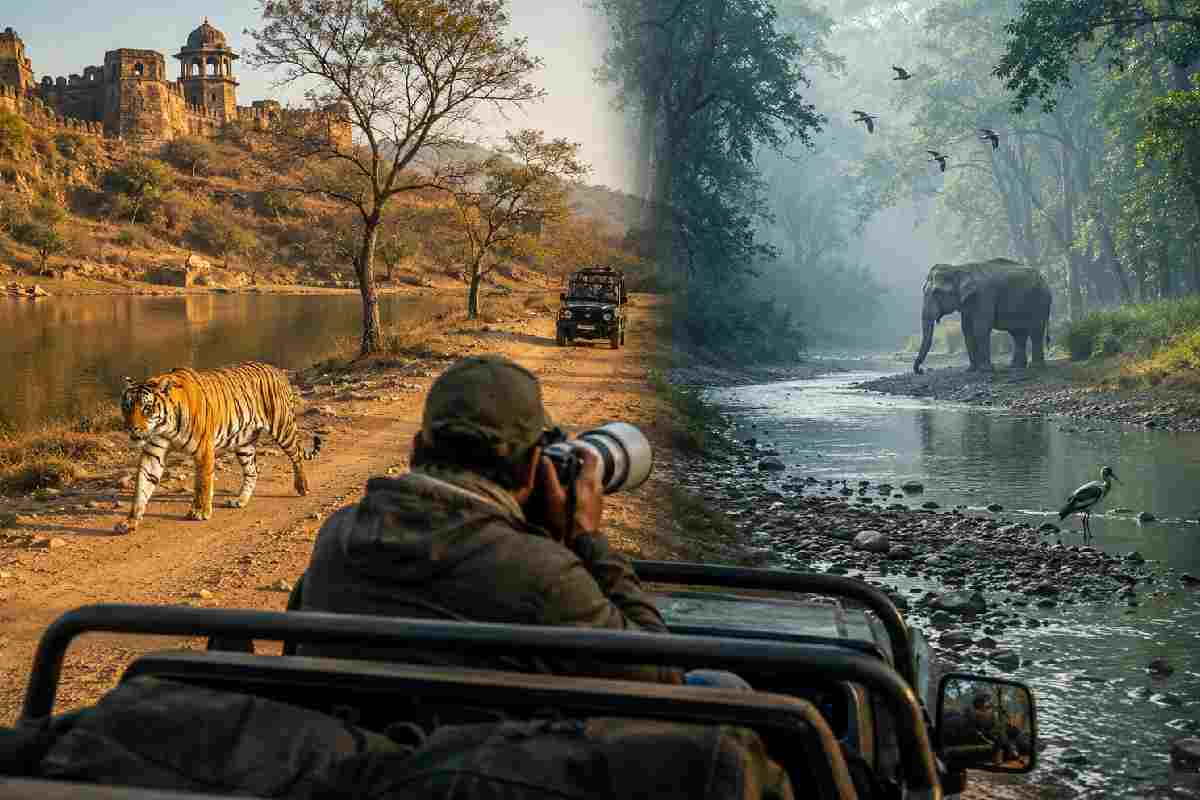
You’ve got five days, November dates, a camera bag, and just under 50,000 to spend. Which do you choose? Corbett or Ranthambore? If your number one reason for heading to India is to take pictures of tigers go to Ranthambore; if however you‘re looking for a more diverse forest experience with more birds, elephants, river shots and a more peaceful feeling go to Corbett.
Simple enough. The catch? A good photography trip isn’t judged by one tiger sighting. It’s judged by the number of useful frames you come back with — and the kind of frames you actually wanted.
This guide is a direct comparison of both parks for a 5 day wildlife photography safari in November on a budget of 50k, based on common sense assumptions of India-based travel, budget/budget+ accommodation, shared safaris where possible and an acknowledgement that no park can guarantee a tiger.
Table of Contents
Key Takeaways
- Tiger photos → Ranthambore gives you better odds and cleaner backgrounds.
- Forest variety → Corbett is stronger for birds, elephants, river scenes, and mood.
- November timing → Both work, but Corbett’s Dhikala zone matters after 15 November.
- ₹50k budget → Possible for one person with trains, budget stays, and shared safaris.
- Best first safari → Ranthambore is usually easier for beginners.
Key Terms (If This Is Your First Safari)
- Core zone: The main tourism area of a tiger reserve with higher historical tiger activity and stricter rules.
- Buffer zone: the outer edge of the reserve where there are wild animals however because of lower tiger density or increased settlement there are often villages or more human activity.
- Gypsy /jeep safari: A small open vehicle (normally 6 seats) used for the wild life safaris has a better angle for photograph.
- Canter safari: Larger open vehicle (approx.20 seats) which is cheaper but less adaptable for serious photography.
Compare Corbett and Ranthambore for a 5-Day November Trip
A Corbett vs Ranthambore comparison for a November photography trip is a practical choice between two styles of Indian tiger reserve travel. It works by weighing tiger visibility, habitat, safari access, travel time, and the number of photo chances you can buy without crossing your ₹50,000 ceiling.
The honest answer first.
For a 5-day wildlife photography trip in November, Ranthambore is usually the better pick if you want tiger images. Not perfect. But better. The terrain is more open, the backdrops are cleaner, and the safari system is easier to plan around for a first serious trip.
Corbett is the better pick if your idea of a strong photo set includes misty sal forest, elephants, birds, riverbeds, gharials, deer, and wide habitat frames. Will you work harder for tiger photos there? Probably. But the range of subjects can be much better.
Quick comparison table
| Factor | Ranthambore | Jim Corbett |
|---|---|---|
| Best for | Tiger portraits, ruins, dry forest, lake backdrops | Forest mood, birds, elephants, rivers, biodiversity |
| Tiger photography odds | Generally stronger visibility | Tigers present, but harder to spot in dense cover |
| Beginner friendliness | Easier for first-time safari photographers | More rewarding if you’re patient |
| November conditions | Open, clearer sightlines, pleasant weather | Cool mornings, mist, lush forest, zone timing matters |
| Budget pressure | Safari demand can push costs up | Can be cheaper, unless you chase premium zones/stays |
| Best base town | Sawai Madhopur | Ramnagar |
| Main risk | Crowds, zone availability, higher safari demand | Less predictable tiger visibility |
Want the cleanest tiger frame possible in five days? Pick Ranthambore.
Want a more layered wildlife folder? Corbett deserves a serious look.
Tiger Photography: Which Park Gives Better Chances?
A note of caution: despite best intentions, no ethical safari operator can promise you a tiger. A national park isn‘t a studio. That‘s irritating when you‘re paying 50,000, but that‘s the reason for being out in the wild.
So the better question then is: which park provides a photographer more productive opportunities in five days?
Ranthambore for cleaner tiger portraits
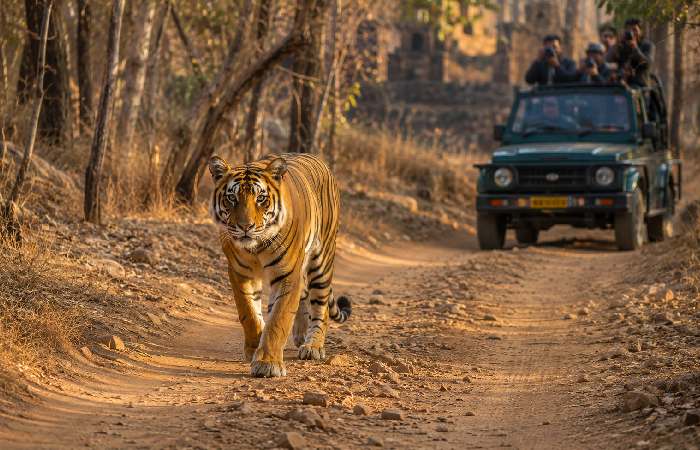
Ranthambore is perhaps a stronger argument for tiger photography. Even Rajasthan Tourism, in their description of Ranthambore, state that it is “one of the most famous wilderness areas for tiger sightings in the wild, when dry-deciduous forest, lakes, hills and the 10 th century fort, set the scene”. These, and other destination details, can be checked on the Rajasthan Tourism Ranthambore page.
That setting matters. A tiger walking near a lake, crossing an open track, or resting near ruins gives you a cleaner frame than a tiger half-hidden inside dense sal forest. The backgrounds can be dramatic without needing a rare angle.
The best part? Even your first time out you don’t have to be an expert tracker to follow all the details. As a beginner with a 300mm or 400mm lens, Ranthambore is generally easier to read. Trip report writers and workshop leader have often commented that most good tiger shots come from straightforward, open trackways as opposed to intense deep corners of wood.
Still, there’s a flaw people don’t mention enough. Ranthambore can feel crowded when a tiger appears. Vehicles gather, angles get messy, and your “perfect” frame may include dust, heads, and other jeeps. Frustrating? Yes. Common? Also yes.
Corbett for harder but richer habitat frames
Corbett is less straightforward for tiger portraits. Dense forest gives animals more cover, so sightings can be brief or partly blocked. You may hear alarm calls, wait on a track, raise the lens, and get nothing but leaves.
But what if your goal isn’t only a tiger close-up?
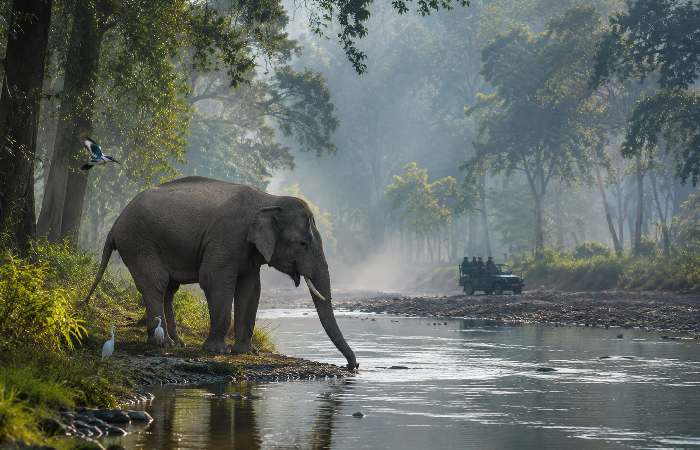
In the same way Corbett offers you a broader profile of wildlife; elephants in the grassland, birds by the water, deer in the mist, riverine woodlands, crocodiles, forest layers. According to the National Tiger Conservation Authority’s tiger reserve list, Corbett and Ranthambore are long-standing tiger reserves, but with very different topography and visitor ambiance.
In practice, Corbett favors submission from artists who work in sets e.g., one wide habitat frame, one shot of the behavior, one of the bird, one of the river, one of the mammal. That‘s a better way of thinking than chasing only a tiger.
Quick Camera Settings Guide for Safaris
- Begin with shutter speeds of about 1/1000s or faster for moving animals and birds.
- Use aperture value approximately f/4–f/5.6 for subject isolation, or f/8 to give additional depth to habitat images.
- Start at ISO 400–800 in bright light and raise the ISO only as necessary in the darker forest areas.
- Use of Auto Focus (AFC / AI servo) and burst mode so you don‘t miss sudden behaviour.
The practical verdict for tiger photos
If you’re spending five days and you’ll feel disappointed without a tiger image, go to Ranthambore.
If you’d still be happy with elephants, birds, misty forest, and a stronger sense of wilderness, Corbett may give you a more satisfying portfolio. Different kind of win. Less obvious, but real.
November Conditions, Safari Zones, and Booking
November is a good month for both parks, but it isn’t the same month in both places. That sounds fussy. It isn’t.
The small timing details can change the whole trip.
Ranthambore in November
Ranthambore is open during the main tourism season of November. In November, upon the the Rajasthan Tourism Web-site, the park‘s open through the months of October June, and encourage reservalbeer well ahead due to the intense rush of visitors.
For photography, November usually means:
- Pleasant temperatures, especially compared with summer
- Good morning and evening light
- Dry-deciduous terrain with improving visibility
- Lakes and ruins as strong photo settings
- High demand for good safari slots
Is November the absolute best tiger-sighting month? Many photographers prefer the hotter months for waterhole activity, but November is more comfortable. For a 5-day trip, comfort matters because you’re doing early mornings, long drives, and repeated safaris.
Corbett in November
Corbett has a more significant November wrinkle. Jim Corbett Tiger Reserve booking official site indicates that Dhikala (complex – year round) opens after monsoon 15 Nov on with the Ramganga conducted. Bijrani and Durga Devi (complex) open year round from 15 Oct on. Jhirna and Dhela (complex) open year-round.
So ask yourself: are your dates before or after 15 November?
Before 15 November, you can still visit Corbett, but you may not have the same access pattern serious wildlife photographers want. After 15 November, Corbett becomes more attractive because Dhikala enters the plan.
Quick tip: verify official booking pages before paying anyone. Official links from Rajasthan Forest Department have direct links to booking and online permit provider for Ranthambore, while Corbett permits should be booked through official park portals only. Use official sites always for current rules, fees and zone openings, and consider quotes from third-party operators as less relevant.
Booking Timeline at a Glance
- 90 days before trip: Aim to book Ranthambore safaris and preferred zones.
- 45 days before trip: Aim to book Corbett safaris and Dhikala stays if available.
- 30 days before trip: Finalise trains and accommodation near gates.
- 7–10 days before trip: Reconfirm permits, hotel pickups, and train timings.
Safari vehicle choice
For photography, a shared vehicle keeps costs down. A private vehicle gives you more control over angles, waiting time, and movement.
That’s the budget fight.
And if you book too many private safaris, 50k can disappear quickly. If you book only these cheaper seats, then you can end up losing control of where the vehicle stops. For most budget photographers the sweet spot is a happy median: shared safaris for quantity, one private if the budget permits.
Lens Choices: Corbett vs Ranthambore
- In Ranthambore, a 100–400mm or 150–600mm zoom works well for open terrain and distant subjects.
- In Corbett, a 70–200mm or 100–400mm is often enough because sightings, when they happen, can be closer and in denser forest.
What to Pack for a Wildlife Photography Trip in India
| Item type | Must‑carry items |
|---|---|
| Camera gear | DSLR or mirrorless body, 70–200mm or 100–400mm lens, spare batteries, extra memory cards, lens cloth, blower |
| Support & protection | Beanbag for rail support, rain cover for camera, light dust cover for lens, small dry bag for gear |
| Clothing | Neutral‑coloured layers (olive, brown, grey), fleece or light jacket, cap or beanie, breathable trousers |
| Health & comfort | Reusable water bottle, basic medicines, sunscreen, lip balm, hand sanitiser, small snack bars |
| Documents | Printed and digital copies of safari permits, ID used for booking, train tickets, hotel confirmations |
₹50,000 Budget Breakdown for 5 Days
For one person, a 5‑day trip can usually be planned close to ₹50,000 if you make budget‑friendly choices on travel, stays, and safari type.
Pre‑Trip Checklist (Before You Book Anything)
- Make up your mind: to go for tiger pictures or for different animals and all kinds of forest sceneries.
- As regards dates, before or after 15 November, if he is thinking of Corbett.
- Verify the rules and costs on the official safari booking portals at these parks.
- In the case of block train tickets, buy from your starting city to Ramnagar or Sawai Madhupur.
- Make a shortlist of 2–3 budget or mid-range accommodation options near main safari gates.
But if 50,000 is, well, two guys, flights, private gypsies, a shined-up resort, the figures are strained right away.
That‘s no magic. These are planning prices and are not set tariffs. Safari, tax, vehicle and booking policy charges and rates can vary so always confirm prices before paying.
| Expense | Ranthambore estimate | Corbett estimate |
|---|---|---|
| Train/road travel inside India | ₹4,000–₹10,000 | ₹4,000–₹10,000 |
| 4 nights budget/mid stay | ₹10,000–₹18,000 | ₹9,000–₹18,000 |
| 4–6 shared safaris | ₹10,000–₹18,000 | ₹8,000–₹18,000 |
| Food and local transfers | ₹5,000–₹8,000 | ₹5,000–₹8,000 |
| Buffer for permits, tips, gear needs | ₹3,000–₹6,000 | ₹3,000–₹6,000 |
| Practical total | ₹32,000–₹60,000 | ₹29,000–₹60,000 |
How Group Size Changes Your Safari Budget
| Group type | What changes | Impact on budget |
|---|---|---|
| Solo traveller | Shares jeeps with strangers, single‑occupancy room | Most flexible for dates and zone choices, but accommodation cost per person is highest. |
| Couple | Shares room and sometimes jeep seats | Room costs drop per person; easier to stay within ₹50k |
| Group of 3–4 | Can split a private jeep and room costs | Best balance of control and cost per person |
Ranthambore estimated budget
A balanced Ranthambore plan:
- Travel by train where possible
- Stay 4 nights in a practical hotel, not a luxury resort
- Book 5 safaris if availability and budget allow
- Prefer shared gypsy seats for photography comfort
- Keep one buffer day or buffer slot for availability issues
Here’s where many people go wrong: they spend too much on the room and then reduce safari count. For wildlife photography, that’s backwards. The safari is the trip.
Corbett estimated budget
Corbett can be slightly easier on the wallet if you avoid premium stays and don’t chase every costly option. Ramnagar has a wide range of stays, and road/rail access from North India is practical.
A sensible Corbett plan:
- Use Ramnagar as your base
- Pick zones based on date and availability
- Consider Bijrani, Jhirna, Dhela, and Dhikala access if your dates fit
- Don’t assume every zone gives the same photo outcome
- Keep mornings free for safaris, afternoons for backups or rest
The tricky bit? Corbett planning can feel less neat than Ranthambore. Zone choice matters more, and a random low-cost safari may not match your photography goal.
5-Day Itinerary Options
Five days sounds generous until you count travel. Then it shrinks.
For most Indian travelers, think of this as three strong safari days plus arrival and departure. That’s still enough if you plan the slots well.
Ranthambore plan
- Day 1: Arrive Sawai Madhopoar, check in, test camera settings, make sure you‘re allowed in the park. If arrival time is suitable do an evening safari.
- The 2nd day; Morning safari, rest, evening safari. Use the first day to practise what you lens can do with dust, light and distance.
- Day 3. Morning safari, evening safari. If you got a tiger make your shots of deer, birds, crocodiles, fort view and forest roads even broader.
- Day 4: One or two safaris based on budget. This is your “try again” day if the first two days were quiet.
- Day 5: Short local buffer, departure, or final morning safari if your train timing allows.
Best target: 4–6 safaris.
Too few? One or two safaris can work for casual travelers, but it’s thin for photography. You need repetition because light, zone, guide, animal movement, and luck all change.
If You Don’t See a Tiger That Day
- Focus on behaviour shots of deer, birds, and smaller mammals.
- Look for patterns in light and habitat so you can plan better angles the next day.
- Use quieter drives to experiment with panning, silhouettes, or wide habitat frames.
Corbett plan
- Day 1: Arrive at Ramnagar, confirm zone permits, keep the evening easy. Early starts are rough if you arrive tired.
- Day 2: Morning safari in an available zone, afternoon rest, second safari if budget allows. Watch for birds and habitat frames, not only tigers.
- Day 3: Try a different zone. Corbett’s strength is variety, so don’t make the trip depend on one track.
- Day 4: Use your best available slot for the zone you care about most. If Dhikala access is possible after 15 November, plan around it early.
- Day 5: Departure or final morning drive.
Best target: 4–5 safaris.
Could you do six? Yes, but Corbett’s travel between gates and the mental fatigue of repeated early starts can catch up with you. Honestly, four well-chosen safaris may beat six poorly chosen ones.
Decision Matrix: Which One Should You Choose?
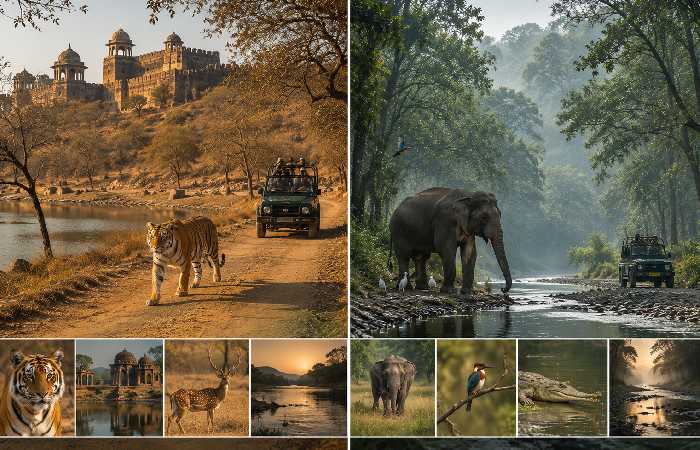
Use this as the final filter. Not perfect. Useful.
| Your priority | Better pick | Reason |
|---|---|---|
| First tiger photo | Ranthambore | More open terrain and cleaner visibility |
| Bird photography | Corbett | Stronger birding reputation and richer habitats |
| Elephant and river scenes | Corbett | Better fit for that subject mix |
| Ruins, lakes, dramatic tiger frames | Ranthambore | More iconic backdrops |
| Quiet forest mood | Corbett | Denser, calmer, more immersive feel |
| Beginner safari planning | Ranthambore | Easier to understand and structure |
| Lowest possible cost | Corbett, usually | More flexibility if planned carefully |
| Best 5-day tiger-focused return | Ranthambore | Often a higher practical chance of usable tiger frames, given its more open terrain and typical sighting patterns. |
Choose Ranthambore if
Pick Ranthambore if your dream frame is a tiger walking in warm light with a clean background. That’s the core reason to go.
Also choose it if:
- You’re a beginner or intermediate wildlife photographer
- You want 4–6 safaris in a simple plan
- You’re okay with crowds around major sightings
- You care more about tiger portraits than bird variety
- You can book early and stay near Sawai Madhopur
One blunt opinion: for a first serious tiger photography trip, Ranthambore is the safer call. Not certain. Safer.
Choose Corbett if
Pick Corbett if your camera doesn’t need a tiger in every frame to make the trip feel worth it.
Also choose it if:
- You enjoy birds, elephants, deer, river scenes, and forest mood
- You’re traveling after 15 November and want Dhikala in the mix
- You prefer a quieter jungle feel
- You’re patient with lower tiger visibility
- You like habitat photography more than portrait-heavy shooting
The frustrating part is that Corbett can be a better wildlife experience and still feel weaker if your only goal is a tiger photo. Know that before you book.
Common Mistakes / Pitfalls to Avoid
What ruins this trip? Usually planning, not the park.
- Booking late, then blaming the park when good safari slots are gone.
- Spending heavily on the stay and cutting safari count. Wrong priority for photographers.
- Assuming “tiger reserve” means tiger sighting. It doesn’t.
- Ignoring Corbett’s 15 November Dhikala timing.
- Choosing the cheapest safari without checking vehicle type, zone, and pickup logistics.
- Carrying only a long lens. You’ll want wider habitat frames too.
- Wearing bright clothing in open safari vehicles. Neutral colors are better.
- Forgetting ID details. Safari bookings often require the same ID at entry.
- Expecting private-vehicle control in a shared safari. You won’t always get the angle you want.
Quick question: would you rather come home with one tiger photo or a complete wildlife set?
If the answer is one tiger photo, you already know the direction. Ranthambore. If the answer is the full set, Corbett gets stronger.
Safety and Ethics: No Photo Is Worth a Risk
- Stay seated and never lean out of a moving vehicle, even for a “better angle”.
- Keep noise low at sightings; loud reactions can disturb wildlife and ruin the moment for everyone.
- Never ask your driver or guide to go off‑track, bait animals, or crowd a sighting for a closer shot.
- Do not feed wildlife, litter, or use harsh flash at close range on animals and birds, especially at night or in dark forest.
Who This Is For / Who Should Avoid
This comparison is for you if:
- It is your first, or second, semi-serious Indian wildlife photography trip.
- You‘re comfortable using a DSLR or mirrorless camera and want to return with images more than dinner-on-the-beach snapshots shot through your phone.
- You are dealing with a 50k practical budget and you want honest trade-offs.
- You care about tiger photos but don’t want fake sighting promises.
- You’re open to shared safaris and budget-conscious stays.
- You want a decision, not a generic “both are beautiful” answer.
This trip style may not suit you if:
- You want luxury resorts, private vehicles, and flights inside ₹50k.
- You’ll consider the trip a failure without a tiger sighting.
- You’re booking at the last minute during peak demand.
- You don’t want early mornings, dust, cold starts, or waiting.
- You need full control over every photo angle.
Wildlife photography is partly planning and partly acceptance. That second part is harder than people admit.
2-Minute Self-Check Before You Decide
- Would you feel the trip was a failure without a tiger photo?
- Do you enjoy photographing birds and smaller subjects as much as big cats?
- Are you okay waking up early for 4–6 drives in a row?
- Does your budget allow for at least one private or low‑occupancy jeep?
If you answered “yes” mainly to tiger obsession and a simple plan, Ranthambore fits better. If you answered “yes” to variety, patience, and atmosphere, Corbett gets stronger.
Final Verdict
For the precise question compare Corbett and Ranthambore for a 5 day wildlife photography trip in November on a 50k budget the sensible answer would be: go to Ranthambore if your top priority is tiger photography, go to Corbett if you want to photograph the forest and wildlife more widely.
Ranthambore offers you better chances for the image most beginners are looking for: a visible tiger in a decent surroundings. Corbett offers you more variation, more atmosphere and a better chance of collecting a more diverse nature portfolio.
If you‘re a first-time wildlife photographer on this budget… I‘d recommend Ranthambore (with 4-6 shared safaris), basic accommodation in Sawai Madhopur, and train travel. If you‘re an experienced photographer who really loves birds, elephants, rivers, and atmosphere… I‘d pick Corbett (particularly once Dhikala is opened for mid-November).
No guaranteed tiger. Still a good plan.
After the Trip: Don’t Forget Your Images
- All of the photos need to be saved to at least 2 different locations once you find a reliable WiFi or your home base.
- Select the top few photos from each day (legend through) and keep a note of how successful the conditions and zone were in for using them again.
Frequently Asked Questions
Which is better for tiger photography, Corbett or Ranthambore?
Thus for most visitors Ranthambore is a location where it is easier to get a tiger shot as the more open habitat and lighter entanglement is acoustics for the photographer. Yes there are tigers in Corbett but the thick forest makes it very difficult for a sighting, let alone a photograph.
Is November a good time for Corbett and Ranthambore?
Yes, for both parks, November is a good one. Ranthambore is in its primary period; when Corbett, after the 15 th of November, it is a (evenmore) interesting park.
Can I do this trip under ₹50,000?
How many safaris should I book in 5 days?
Playing four to six safaris is a good move. Less than three and you‘ve got too little room in the form of silent drives, poor light or unfortunate zone allocation.