


Before you hand over your PAN, spend hours on unpaid tests, or plan your month around Soul AI queues, you need honest answers: is it legit, how much does it really pay, and what’s the catch? In this review, you’ll see how Soul AI hires, pays, and manages experts, where it shines, where it falls short, and the kind of person who will actually benefit from working with them.
Table of Contents
Quick Answer:
Soul AI is a legitimate enterprise AI platform dual-headquartered in New York and Hyderabad. Backed by Prosus Ventures, it connects domain experts (doctors, lawyers, coders) with high-paying RLHF (Reinforcement Learning from Human Feedback) tasks. While pay is competitive, work availability is volatile, and internal office roles mandate a high-intensity 6-day work week.
Pros and Cons
Pros
- Backed by a known venture investor with a clear corporate structure.
- Higher-than-average pay for experts in medical, legal, and technical domains.
- Remote, flexible freelance work for most expert tasks.
- Exposure to cutting-edge RLHF and SFT projects for major LLMs.
Cons
- Work availability can swing from very busy weeks to completely empty queues.
- Mandatory government ID verification may concern privacy-conscious users.
- Support can feel slow or unresponsive between active projects.
- On-site roles at the parent company demand a mandatory 6-day work week.
What is Soul AI? The Deccan AI & Prosus Connection
Soul AI operates as the expert-facing arm of Deccan AI, a model training and evaluation firm founded by alumni from IIT Bombay and IIM Ahmedabad. Unlike generalist data-labeling sites, Soul AI positions itself as a premium “Cognitive Supply Chain” provider, working with a large pool of advanced degree holders and subject-matter experts to refine Large Language Models (LLMs) using techniques like Reinforcement Learning from Human Feedback (RLHF) and Supervised Fine-Tuning.
The firm is dual-incorporated with offices in Wilmington, Delaware and Gachibowli, Hyderabad. Its legitimacy was significantly bolstered when Deccan AI announced successful funding from Prosus Ventures in 2025.
Is Soul AI Legit? Addressing Scam and Privacy Concerns
User skepticism often stems from two factors: the requirement of sensitive government IDs (PAN/Aadhaar) and poor support communication.
Identity Verification:
Soul AI requires a government-issued ID to prevent “AI training AI” fraud and to comply with tax regulations, similar to how major freelance marketplaces implement Know Your Customer verification for higher-risk or higher-paying work.
Support “Ghosting”: A notable share of user reports describe a lack of response from support. This is typically due to the project-based nature of the work; when a specific model training cycle ends, support becomes far less responsive until a new project launches.
Verified Payouts: Despite communication gaps, Soul AI reports consistent payouts to freelancers and experts, with total payments reaching into the high six- or low seven-figure range in recent periods, based on available figures and user reports.
The “Expert” Tier: How Professionals Monetize Knowledge
Soul AI focuses on Subject Matter Expertise (SME) across 50+ domains. The work is categorized into two main types: SFT (Supervised Fine-Tuning), where experts write “Golden Answers” to complex prompts, and RLHF (Reinforcement Learning from Human Feedback), a widely used method for aligning language models with human preferences as documented in instruction-following model research.
- SFT (Supervised Fine-Tuning): Writing “Golden Answers” to complex prompts to show the AI how a human expert reasons.
- RLHF (Reinforcement Learning from Human Feedback): Ranking two AI responses and justifying the choice based on factual accuracy, safety, and tone.
Domain Examples
- Medical: Reviewing AI-generated diagnostic reasoning for clinical accuracy.
- Legal: Redlining contracts or identifying legal facts from unstructured data.
- Coding: Debugging Python/SQL scripts and optimizing algorithm efficiency.
- Humanities: Evaluating the moral depth and historical context of literary analysis.
The Vetting Process: How to Pass the Soul AI Assessment
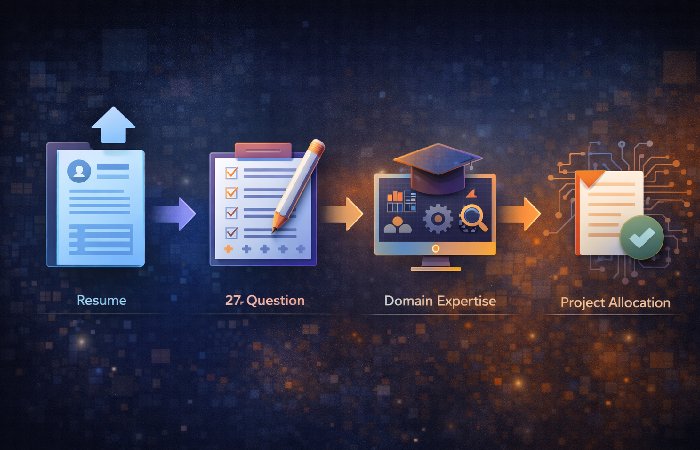
Getting shortlisted requires passing a multi-stage funnel designed to filter for high-order logic.
The Baseline Test: A mandatory 45-minute assessment with 27 questions. This test measures English proficiency, grammar, and the ability to follow intricate instructions.
Project-Specific Screening: After the baseline, you may face domain-specific tests (e.g., SQL coding challenges or medical diagnostic reviews).
Project Shield: A common entry project where you evaluate “Agentic” responses using 11 specific rubrics, including truthfulness, conciseness, and tool-call grounding.
How to Get Hired and Pass the Assessment (Step-by-Step)
If you’re serious about getting into Soul AI as an expert, here’s a straightforward path:
- Clarify your domain
Decide whether you’re applying as a generalist (good English + reasoning) or as a domain expert (medical, legal, coding, finance, etc.). - Prepare your CV and proof of expertise
Have an updated resume, LinkedIn, and any relevant licenses, degrees, or published work ready. These help you stand out when projects need credible experts. - Practice following complex instructions
The 27-question baseline test is less about raw IQ and more about reading carefully and not missing small details. Practice timed reasoning and reading-comprehension questions. - Brush up domain basics
For coding, review core language syntax, debugging, and SQL queries.
For medical/legal, refresh guidelines, terminology, and typical edge cases. - Do a mock “RLHF” session
Take two sample AI answers (from any public model) and practice:- Choosing the better one.
- Writing a short justification focused on facts, safety, and clarity.
- Manage your environment on test day
Use a stable internet connection, a quiet place, and avoid multitasking. The baseline test is time-bound and penalizes second-guessing and distractions. - Stay available post-test
After you pass, check your email and dashboard regularly. Projects can appear and disappear quickly; fast responses can get you onto better-paying or longer-term assignments.
Compensation Reality Check: Hourly Rates and Volatility
Soul AI’s rates are higher than local Indian data-entry norms but often lower than some US-centric platforms like Outlier.
| Role Category | Example Tasks | Approx. Hourly Rate* |
| Medical Expert | Check clinical reasoning, review health outputs | ₹1,000–₹1,500+ / $10–$20 |
| Legal Expert | Review contracts, compliance, legal reasoning | ₹1,000–₹1,500+ / $10–$20 |
| Coding Specialist | Debug code, review algorithms, write golden answers | ₹1,000–₹1,500+ / $10–$20 |
| Generalist/Writer | Rank responses, write explanations, review tone | ₹500–₹800 / ~$7–$10 |
*Ranges are approximate and can change; always confirm in current offers.
- Generalist/Beginner: Typically around ₹500–₹800 per hour.
- Specialist (Coding/Legal/Medical): Often in the ₹1,000 to ₹1,500+ per hour range, depending on domain and project.
Payment Frequency: Payouts are usually bi-weekly (twice a month) via direct bank transfer.
The “Empty Queue” Risk: The biggest drawback is work inconsistency. You may have 40 hours of work one week and zero the next as projects end abruptly without warning. It’s best treated as a side-income stream rather than a guaranteed full-time salary.
Soul AI vs Other AI Work Platforms
| Feature | Soul AI | Outlier / Scale-style platforms | Data Annotation vendors |
| Focus | Expert-led RLHF & SFT | Mix of expert and general tasks | General data labeling |
| Typical Pay | Medium (around $10–$20/hr for specialists) | Often higher for US-based experts | Medium, varies by client |
| Vetting | High, structured assessments | Medium, varies by project | High / sometimes opaque |
| Work Pattern | Project-based, can be volatile | Project-based, variable queues | Project-based, volume-driven |
Comparison: Soul AI vs. Outlier vs. Data Annotation
| Feature | Soul AI / Deccan | Outlier AI | Data Annotation |
| Primary Region | Global (focus on India/US) | Global (focus on US/UK) | US, UK, Canada, NZ |
| Specialist Pay | About $10–$20/hr | About $30–$50/hr | About $20–$40/hr |
| Vetting | High (27-question test) | Moderate (varies) | Extreme (opaque) |
| Legitimacy | Prosus-backed platform | Scale AI–associated | Specialized independent vendor |
This table reflects typical bands and practices rather than exact, guaranteed numbers; rates can vary by project, profile, and timing.
Who Soul AI Is Best For (And Who Should Avoid It)
Best for:
- Domain experts (doctors, lawyers, engineers, data people) looking for flexible side income.
- Strong English speakers who enjoy analytical, logic-heavy tasks.
- People who want hands-on experience with RLHF, SFT, and LLM evaluation work.
- Freelancers comfortable with variable monthly income and project-based workflows.
Probably not ideal for:
- Anyone needing a stable, full-time salary they can rely on month after month.
- People uncomfortable sharing government ID details for verification.
- Those who want instant customer support and predictable work queues.
- Individuals who dislike detailed guidelines, rubrics, and quality checks.
Workplace Culture: The “6-Day Week” Controversy
While the freelance network is remote, the core operational team at Deccan AI (Hyderabad) operates under a specific “Hustle DNA.” Job postings for internal roles explicitly mandate a 6-day work week with Sunday as the only off-day. Management describes the environment as “not for the faint-hearted,” emphasizing rapid turnarounds for clients like large tech and AI companies.
If you are considering an internal office role rather than a freelance contract, factor this into your work–life balance expectations.
FAQ
Q1. Is Soul AI a scam for free labor?
Soul AI is a venture-backed company that does pay experts for approved work, usually on a bi-weekly schedule. Some people still feel “scammed” when unpaid assessments, long gaps between projects, or unclear communication make the process feel one-sided.
Q2. How do I get paid by Soul AI?
Payments are typically processed every two weeks via direct bank transfer to the account details you provide. You are paid only for tasks that have been completed, reviewed, and approved according to the project rules.
Q3. Why did my Soul AI account get suspended?
Accounts are usually suspended for issues like collusion (working with others), using AI tools to complete tasks against the rules, or repeatedly failing quality checks on projects such as “Project Shield.” If this happens, you normally need to contact support and ask if an appeal or review is possible.
Disclaimer
This article is for informational and educational purposes only and does not constitute financial, legal, or career advice. Details about Soul AI, including roles, pay rates, work culture, and hiring processes, may change over time and can vary by individual, location, and project. Readers should always verify key information directly with Soul AI or any prospective employer before making career or financial decisions. The author and publisher do not accept responsibility for any losses, decisions, or outcomes arising from the use of this information.
Author Bio
Technologyford publishes clear, plain-language guides on work, AI, business, and everyday topics, using reputable public sources and minimal jargon to keep information easy to understand.
About the Author & Methodology
This article is based on publicly available information (official sites, listings, reviews) plus general knowledge of AI training and remote work. AI tools help with research and organisation. All figures (pay, timelines, workload) are approximate and may change; please verify key details directly with Soul AI or other official sources before deciding.