
Football in India has moved from a passionate, localised culture to a nationally packaged, prime-time product, and the Indian Super League (ISL) has been the biggest accelerator of that shift. Launched on 21 October 2013 and first played in October 2014, the ISL brought modern broadcasting, recognisable club identities, and a season format designed for consistent attention.
Table of Contents
The Rise of Football in India and the Impact of the Indian Super League – Quick Answer
The ISL helped football grow in India by making the top domestic league easier to watch, easier to follow, and more clearly structured. Founded in 2013 and first played in 2014, it expanded from 8 teams to 14, earned AFC recognition after its first three seasons, and became India’s sole top-tier league from 2022–23, strengthening the pathway from domestic success to Asian competitions.
From Heritage Tournaments to a National League Identity
Indian football did not begin with the ISL; it began with history, community, and long-running competitions.
The Durand Cup started in 1888, long before India had a nationwide league structure. For decades, clubs mainly competed in state leagues and select national tournaments, which kept rivalries intense but limited the sport’s week-to-week national narrative. A true nationwide league arrived later with the semi-professional National Football League in 1996, giving fans a more consistent calendar and giving players a clearer competitive ladder.
In 2006, the All India Football Federation (AIFF) reformatted the league into the I-League to professionalise the game. The intent was clear: better organisation, stronger clubs, and a product that could compete for attention in a crowded sports market. Marketing and visibility, however, remained uneven, and that gap mattered because football needs repetition on screens and in stadiums to build habits among casual viewers.
Why the ISL Was Created and What Made It Different
The competition was founded on 21 October 2013 to grow football in India and increase its exposure, and that mission shaped the league’s early design choices.
From the start, the ISL used a franchise-style approach that mirrored the Indian Premier League’s entertainment-forward model. In the first phase, each season lasted about three months, running from October to December, and matches were held daily. For beginners, this explains why the league quickly became visible: a short, intense schedule is easier to market and easier to sample, especially for viewers who are still deciding whether to follow a club week after week.
During its first three seasons, the competition operated without official recognition from the Asian Football Confederation (AFC). That detail matters because AFC recognition influences how a league is viewed in the wider Asian football ecosystem and how smoothly it connects to continental pathways.
The First Season: A Mainstream Launch
The inaugural season began on 12 October 2014 at Salt Lake Stadium, where Atlético de Kolkata beat Mumbai City 3–0. The first goal was scored by Fikru Teferra, and Balwant Singh became the first Indian to score in the league for Chennaiyin FC.
The original footprint was designed to feel national from day one. The selected cities and states included Bangalore, Delhi, Goa, Guwahati, Kochi, Kolkata, Mumbai, and Pune, before Chennai replaced Bangalore due to ownership changes announced on 21 August 2014. The early ownership mix also helped the league cut through to casual audiences: Sachin Tendulkar was linked to the Kochi franchise bid, Sourav Ganguly was part of the Kolkata bid alongside Atlético Madrid, and Bollywood names such as John Abraham, Ranbir Kapoor, and Salman Khan were involved with Guwahati, Mumbai, and Pune franchises respectively.
Marquee signings added instant familiarity for new viewers. Names like Luis García, Elano, Alessandro Del Piero, Robert Pires, David James, Freddie Ljungberg, Joan Capdevila, and David Trezeguet created a bridge between global football culture and Indian matchdays, while local players gained a higher-profile stage to be noticed.
Recognition, Expansion, and a Longer Season
Before the 2017–18 season, the ISL expanded to 10 clubs with Jamshedpur FC and Bengaluru FC joining, extended its schedule to six months, and earned AFC recognition. That combination shifted the league from a short festival into a more traditional season, which supports coaching continuity, player development, and stronger fan routines.
Today, the ISL is administered by the AIFF and sits at the top of the Indian football league system. It is currently contested by 14 clubs, and the season runs from February to May with a 13-round league stage. For a newcomer, the key takeaway is predictability: a defined window on the calendar and a league stage long enough to reward consistency, not just short bursts of form.
Football fandom in India is also increasingly mobile-first. Many fans follow fixtures, highlights, and discussions alongside other downloads they keep on their phones, including yolo247 apk, which reflects how matchday attention now lives inside a broader digital routine.
What “Sole Top-Tier” Status Changed
The ISL attained sole top-tier league status from the 2022–23 season, with the I-League demoted to the second tier. This was more than a label: it clarified the hierarchy for fans, players, and clubs, and it made the ISL the primary reference point for the highest level of domestic football.
Promotion links also became more tangible. The 2023–24 season saw a directly promoted club from the I-League participating in the ISL for the first time, with Punjab FC joining as the 2022–23 I-League champions to become the 12th league member. In subsequent years, Mohammedan SC and Inter Kashi joined as the 13th and 14th clubs respectively, also as I-League champions. For beginners, this matters because it signals a pathway: strong performance in the second tier can translate into a place on the biggest domestic stage.
How the ISL Decides Winners and Why the Format Is Beginner-Friendly
The ISL’s current structure is straightforward once you know the terms.
- Season window: the league runs from February to May.
- League stage: a 13-round league stage sets the table.
- Champion: at the end of the league stage, the club finishing first in the league table is declared champion and awarded the ISL trophy.
- Asia: ISL clubs qualify for Asian continental club competitions, and ISL winners qualify directly for the subsequent season’s AFC Champions League Two group stage.
This clarity helps new fans follow the stakes. A league table rewards consistency across weeks, and the continental link gives Indian clubs a reason to measure themselves beyond domestic rivalries. Even if you are new to Asian competitions, the idea is simple: perform at home, earn the right to compete against clubs from other countries.
Clubs, Titles, and the Storylines That Built Loyalty
Winning creates memory, and memory creates fandom.
Since the league’s inaugural season, six clubs have won the ISL trophy: ATK (3 titles), Chennaiyin (2), Mumbai City (2), Mohun Bagan (2), Bengaluru (1), and Hyderabad FC (1). These numbers give newcomers a quick map of the league’s power centres across eras, from early dominance to newer champions.
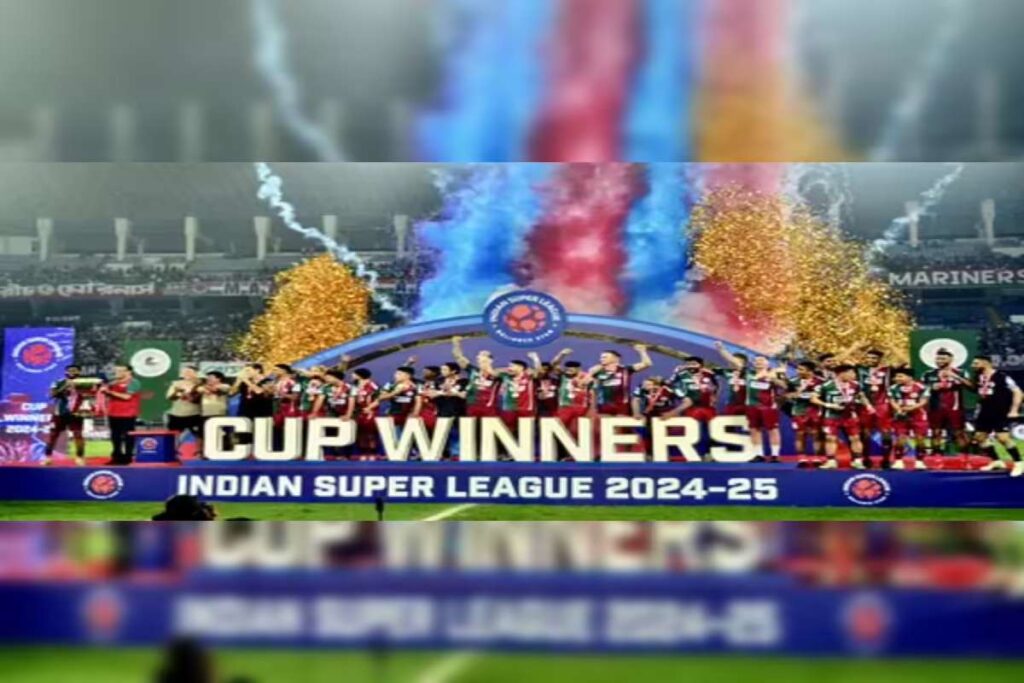
The League Winners’ Shield, introduced in the 2019–20 season, added another layer of meaning to the league stage. Mumbai City and Mohun Bagan have won it twice each, while Goa and Jamshedpur have won it once each. In the 2024–25 season, Mohun Bagan became the first team to successfully defend the League Shield, and also became the first team to earn 50 points or more in the league, setting a record with 56 points in the 2024–25 league season.
Why Visibility and Scheduling Drive Growth
Football grows fastest when it becomes easy to find and easy to follow.
In the early phase, the ISL’s daily-match rhythm during a three-month window created a habit loop for viewers: tune in, learn the teams, recognise the players, repeat. As the league expanded and moved toward a longer season, it gained the ability to tell deeper stories across months rather than weeks, including form swings and the slow build of rivalries.
For beginners, the practical impact is simple: a defined season window from February to May, a stable set of clubs, and consistent coverage make it easier to become a regular viewer rather than an occasional spectator.
A Beginner’s Guide to Following the ISL Season
Getting into the ISL does not require deep tactical knowledge; it requires a few smart starting points.
- Pick one club to follow for a month so you learn player names and basic patterns of play.
- Track the league table weekly, because the ISL trophy goes to the team finishing first in the league stage table.
- Add one cup competition to your viewing, such as the AIFF Super Cup or the Durand Cup, to understand squad rotation and priorities.
- Watch the race for Asian qualification, since the ISL winner reaches the next season’s AFC Champions League Two group stage.
This approach keeps the learning curve gentle while still giving you enough structure to understand why a mid-season win or loss can change the entire mood around a club.
What the ISL’s Rise Means for Indian Football Culture
The ISL did not replace India’s football history; it repackaged it for a modern audience and created new entry points for fans who grew up with other sports.
By moving from eight teams in 2014 to 14 clubs today, and by becoming the sole top-tier league from 2022–23, the ISL has made the domestic pyramid easier to explain and easier to market. Its early marquee era created attention, its later AFC recognition improved legitimacy, and its current February-to-May season gives Indian football a consistent annual spotlight. For newcomers, the biggest impact is confidence: following Indian football now feels like following a major league, with clear stakes and recognisable clubs.
FAQ
Q: Is the ISL the highest level of football in India?
A: Yes. From the 2022–23 season, the ISL became the sole top-tier league, with the I-League positioned as the second tier.
Q: Why did the ISL start with a short season and daily matches?
A: Early seasons ran roughly from October to December with matches held daily to concentrate attention and make the league easy to follow for new audiences.
Q: What changed when the ISL received AFC recognition?
A: AFC recognition strengthened the league’s standing in Asian football and supported clearer links between domestic performance and continental opportunities.
Q: How does a club become ISL champion in the current format?
A: The club that finishes first in the league table at the end of the 13-round league stage is declared champion and awarded the ISL trophy.
Q: What made Mohun Bagan’s 2024–25 league season notable?
A: They became the first team to defend the League Winners’ Shield and set a points record with 56, also becoming the first to cross 50 points in a season.